Thursday, December 30, 2021

Book Review: A Writer's Opinion

 Mrs England by Stacey Halls


I think I came across Mrs England on Goodreads. It was a Sunday Times Bestseller. Stacey Halls' debut novel, The Familiars, based on the Pendle Witch Trials, was the biggest selling debut novel of 2019, and I had heard of it, if not of her. Her second novel, The Foundling, was also a bestseller, but I hadn't read either of these earlier novels when I started reading Mrs England, and the name Stacey Halls was unfamiliar to me.


The novel is set in Edwardian England and its heroine, Ruby, is a young working-class woman who has recently trained to be a Norland nanny. The details about the training of such nannies is fascinating, and Halls maintains an intriguing mystery about Ruby herself that is not uncovered for the reader until late in the story. Ruby's personal story was one of the elements I found most compelling and, though Halls releases hints throughout, it is still a suitably dramatic and poignant narrative device, adding an extra layer of reader-understanding of Ruby's character and an extra layer of mystery to the central plot which concerns the Yorkshire mill-owning family for whom Ruby goes to work.

The Mrs England of the novel's title is the lady of the house, an apparently neurotic, secretive, peculiarly distant character who seems strangely lacking in interest in her children. Halls makes full use of the 'northern gothic' aspects of the Yorkshire setting, and is clearly indebted to iconic novels such as Jane Eyre and Wuthering Heights, The Turn Of The Screw, and to other versions of the archetypal governess story such as The Sound Of Music (there are even hints of Kipps and Hobson's Choice here and there), though her novel has a much more modern sensibility. She has been described as the successor to Hilary Mantel, but, based on this novel, I consider that a stretch. Nevertheless, the book is a well-written, well-plotted historical narrative which refuses to dissolve into cliche and sentimentality. It is frequently surprising in its twists and turns, and the melodrama, though present, is carefully controlled.

I found the novel enjoyable but it didn't make me want to read Halls' other work - I might well do so at some stage, but I can't imagine Mrs England becoming a novel I return to any time soon. I am not a particular lover of historical fiction, except when it is given a shot of energy by being exceptionally atmospheric or being played for laughs or being in a specific subgenre of fantasy such as steampunk. Mrs England is firmly in the realist tradition, though the plot is moderately far-fetched, and Halls is clearly an advocate for women's rights. Her work highlights the way that toxic masculinity constrained women in the past, but also presents us with a couple of women who overcome these constraints. This is uplifting but ultimately unconvincing in a story which presents itself as a realistic tale. When I compare it to the other novel I know well, set in the Edwardian period and focusing on a wealthy family - The Go-Between by L.P.Hartley - Halls' novel falls very short.

Nevertheless, I would recommend this novel to readers who enjoy historical fiction and who are looking for something competently-written and engaging.

RATING: Mrs England **** 

Key:
*****      highly recommended - a 'must-read'
****         good -  worth taking the time to read
***           ok - will help to pass the time in a boring situation
**            not very good -  just about readable but flawed
*             not recommended - boring, offensive, badly-written or deeply flawed in some other way


Saturday, December 11, 2021

Book Review: A writer's opinion

 The 'Circles of Hell' series by Mark Cain:


Novels in order:

Hell's Super
A Cold Day In Hell
Deal With The Devil
The Reluctant Devil
I'm No Angel
Beelzebub: A Memoir
Saint Peter Takes A Holiday (or It's About Time)
The League Of Unusual Denizens
A Room Of Steve's Own


Website address:  https://markcainwrites.com/


Every so often, when I can't face a 'proper' novel but I need a bit of relaxing distraction, I turn my attention to what I mentally categorise as 'easy reading cosy comic fantasy' - the Inspector Hobbes series, reviewed elsewhere on this blog, is one such series, and Jodi Taylor's time-travelling historian is another. Most books by Heide Goode and Iain Grant fall into this category too (at the top end). Mark Cain's 'Circles Of Hell' series fulfils this requirement in my reading repertoire.
        I have to come clean and admit that these books aren't great literature. They aren't even high up on my mental list of 'easy reading' novels. BUT they do have a soft heart, a gentle humour, amusing characters and a ridiculous premise, so if you are looking for something to read that will pass the time in a doctor's surgery or a queue or at a bus-stop, or will lull you gently to sleep at night, this might be a good choice for you.
        I will say that I am currently reading The League of Unusual Denizens and I'm enjoying it, in a mild, unthinking way. The basic idea of these stories is that the protagonist, Steve Minnion, died some decades ago and has been sent to Hell. It is a traditional hell with lots of fire, brimstone and torture, demons with pitchforks and suchlike, but mostly it is just a place where things that would be irritating in the real living world reach their apotheosis. Steve is Hell's Superintendent when the series begins (he later becomes Heaven's ambassador plenipotentiary), accompanied by his best friend Orson Welles (yes, the Orson Welles). The role of superintendent essentially means he is a kind of janitor, all-round incompetent handyman (this being Hell), and was appointed to the position because he has absolutely no aptitude for the job.  Except that, in fact, Steve has many excellent qualities - he is quite clever, good-humoured, kind and caring, loyal, friendly. He even gets on well with Beelzebub. He clearly isn't evil. And Hell seems to be full of people who you feel don't deserve to be there, including Steve's love-interest Florence Nightingale (yes, the Florence Nightingale). You find out later in the series why this is. 
        I think you can gather from that summary what kind of novels these are. They are full of puns, silliness and daft ideas, with very little making sense. You have to suspend your disbelief (and indeed your critical faculties) in order to enjoy the stories, but the warmth and good humour are very relaxing. It is difficult having a hero who is such a good guy - Steve is a rebel in Hell because he is clearly too nice a bloke to be there. He is Everyman, if Everyman is a kind-hearted, thoughtful, cheerful sort with excellent people skills. 
        The stories are mostly flimsy and nonsensical, and the writing is straightforward and at times naive in its style, but I find the books are like a reviving hot chocolate after a warm bath at the end of a long day's labour - easy-going, simple, mildly humorous, often ridiculous. Just don't try reading the next one straight after the previous one as I would imagine it would be like eating too many macaroons or jam tarts.

 RATING: Circles of Hell series  ***


Book Review: A Writer's Opinion


The Starless Sea by Erin Morgenstern

Erin Morgenstern is a young, good-looking, talented multi-media artist who has written two best-selling fantasy novels, so I ought to be intensely jealous of her. However, there is something so magical about her writing that it just makes me feel waves of warmth.  I can even forgive the fact that she seems to be into horoscopes and drinks a lot of tea.


I read The Night Circus probably around a decade ago, soon after it was published, and I found it strange, mysterious, gripping and beautiful. However, I have never been tempted to re-read it, and I can’t remember all that much about it now. It had a quality shared by another of my favourite writers, Frances Hardinge: the creation of a peculiar but compelling world, similar to but more interesting than the ‘real world’. In Morgenstern’s first novel, this was the world of The Night Circus, capturing the timeless weirdness of all that is carnivalesque – circus, travelling fair, theatre. In The Starless Sea, this other world that exists alongside our own is an underground universe, level upon level, with a sea made of honey, a pirate who is also a metaphor, trompe l’oeil doors that actually open and a series of ornate library rooms lined with enough books to satisfy the most ardent bibliophile.

              The protagonist of The Starless Sea is Zachary Ezra Rawlins, a postgrad student at a US university who, as a child, failed to take a chance and thereby missed his first opportunity to discover the endless libraries of the harbour. He is drawn into a mysterious and dangerous world, meets the love of his life, and helps to complete a story that has been unfolding for generations. In this respect, it bears some resemblance to Little,Big by John Crowley (also reviewed on here). It also reminded me a little of Scarlet Thomas’s novels, though the style is quite different. Morgenstern writes in an alluring, dreamlike prose, verging at times on the purplish but generally remaining on this side of enjoyable.  In fact, it is the beauty of her writing that kept me reading, though I can understand that it might wear thin for some readers. She does share Thomas’s interest in symbols and magic, however. Zach’s mother, the clairvoyant, could have stepped straight out of a Thomas novel.  

              One particularly skillful aspect of the writing is her use of original ‘fairy-tales’, short fables which pepper the central story and lend it depth and variety. The novel moves about a lot, jumping from character to character, location to location, and making excellent use of intertextuality – the fables, and the extracts from one of Zach’s university friend’s diaries, revealed Morgenstern’s skill at writing in different voices and styles. Morgenstern is a skillful and thoughtful writer. Her characters are interesting and her ideas highly imaginative, but there is a slightly-too-large psychic distance between story and reader at times.

              I did enjoy this novel. At least, I did until the last fifth when the narrative became unruly and unclear (to me at least). I found myself, towards the end, beginning to wish it was over. I felt that I was losing interest in the plot which seemed increasingly convoluted and, even after the novel ended, I wasn’t absolutely sure about what the story actually was. This probably suggests a defect in my understanding as much as anything. I felt that a great deal of mystery was set up early on, and though it was resolved I was still left a little confused and unsatisfied. Nevertheless, I think it is a novel worth reading, if you like fantasy of the off-beat, magical, New Age variety.   


RATING: The Starless Sea ****

Friday, November 19, 2021

BOOK REVIEW: A writer's opinion


Kate Atkinson

A God In Ruins (Costa Award Winner 2015)

Not The End Of The World (short stories)


I am a great fan of Kate Atkinson and, if I could write like her in even a small way, I would be thrilled. Ever since I read ‘Behind the Scenes at the Museum’, in my early twenties, I have loved her work.

I particularly enjoyed the Jackson Brodie series, helped by the TV dramatisation starring Jason Isaacs at the height of his sex appeal. Atkinson is an award-winning, literary writer, ambitious, confident and original, but she also has the ability to write in an extremely compelling and readable style, and the capacity to bend, combine and reinvigorate genres. I have tried to analyse her technique but it is difficult to actually see it, which I think is the point. She writes in an apparentky effortless way.

There is a pacy fluidity to her prose, which is tightly packed with narrative detail but still not bogged down in unwieldy imagery or purple prose. Her characters leap off the page, poignant, plausible, monstrous. Her plots twist and turn, taking the reader down unexpected alleys. She is not averse to making use of magic realism and exploring new ways of telling a tale, but her writing never seems forced or precious.

This year, I have read two of her books. One was a collection of short stories I downloaded when I was doing my MA in Creative Writing last year, as I had to write an essay on the short story as a genre. However, I never actually got round to reading her collection at the time as I had so much else to read. I started reading it a few months after I graduated and found myself rapidly pulled into the linked but independent tales, which was quite a surprise as I don’t generally read volumes of short stories very often (except for the purposes of university essays!).


I’m not generally keen on volumes of short stories, though I like the genre in itself. I prefer to read short stories in occasional small doses and collections tend to invite you to keep reading. Generally, I find I end up with a cloying feeling of having read too much, my mind clogged with different characters and events that each exist in its own bubble.

Atkinson’s collection overcomes this by being a series of interconnected short stories, bound together by the classical myths that underpin them, though this classical inspiration is not always obvious to a casual reader despite several newspaper reviewers implying that the magical realism aspect is overdone. Personally, I felt it was often very subtle, as when a dead woman who later comes back to life sees pomegranate seeds in a dish, reminding us of the tale of Persephone. Where it is more obvious, as when the nanny, Missy’s, boots turn into silver sandals and a quiver of arrows appears on her back, it felt quite natural and thematically appropriate. One critic I read suggested that Atkinson’s use of Latin and Greek quotations at the start of the stories serves mostly to highlight the triviality of the tales themselves, and that it was unclear why Atkinson had chosen Ancient Greek mythology as her underlying inspiration, as opposed to myths from other cultures. However, I would counter this by asking why not?  And I would also say that, for me, these stories sparkled with vivacity and were a sheer pleasure to read, so if Atkinson wishes to indulge herself and show off her knowledge, that’s fine by me.

            The links between the stories aren’t always obvious, particularly on a first reading. Some characters are referred to in different stories, and there is an echoing here and there of themes and ideas. One review I read claimed that Atkinson was in love with the sound of her own voice in these stories, implying that they lacked depth and genuine meaning, and I can see how readers might feel this, certainly with some of the more superficial tales. However, I felt that even the most obvious, the ones that used most literary trickery and experimentation for its own sake, were still highly readable, and some of the stories have stayed with me months after I read them – particularly the story of the boy whose prostitute mother is dying of cancer.

              What makes these stories so compelling is Atkinson’s characteristic verve and energy. They fizz along and carry the reader with them. I found the characters vivid and convincing, though their stories were often far from realistic. The stories also radiate with flashes of Atkinson’s wonderful dark humour. All collections of short stories are going to contain individual pieces that appeal more or less to different readers, that are objectively various in terms of quality even, but I enjoyed even those stories I felt were the weakest in the collection. I have read this collection twice this year, which I can’t say about any other volume of short stories I’ve read, including those of the fabulous Alice Munro.


RATING: Not The End Of The World *****


The second Atkinson book I read this year was a long novel which won the Costa Prize in 2015. I had downloaded a few of her novels, and decided, quite randomly, to read this one, not realising quite how long it is until I was well into it and fully involved in the story.

It tells the story of Teddy Todd, a World War 2 fighter pilot, beginning in his childhood and narrating his life story and those of his daughter and grandchildren.  Having not read ‘Life After Life’, I didn’t realise that Teddy is actually the much-loved younger sibling of a character from that novel, Ursula, but that doesn’t matter at all as this novel stands entirely on its own.

              As I write this, I haven’t finished the book so this review is rather pre-emptive. Nevertheless, I enjoyed the chapters I have read very much. The novel moves about in time with little warning – the reader simply has to keep up – but this didn’t feel like a chore, and I found it easy to work out where we were in chronological terms. Teddy is a charming child, realistic and sympathetic. He has the fortune/misfortune of being immortalised by a family friend in a series of popular children’s novels (clearly based on Richmal Crompton’s Just William books) about the redoubtable Augustus, novels he is vaguely embarrassed by. Teddy grows up to be a decorated war hero, but his marriage to his childhood sweetheart, Nancy Shawcross, is an unhappy, unfulfilling one, and his daughter, the hideous Viola (a brilliant monster of a woman whose behaviour made me laugh and cringe simultaneously), is a disappointment. He has a better relationship with his grandchildren, however, who are both damaged to some degree by their ridiculous, self-centred mother.

              I had to leave the novel at the point where Atkinson is just beginning to describe Teddy’s experience of the war, which has been hinted at in previous chapters but not fully explored, but the writing so far makes me know that I will return to it soon to finish reading it. I have an inkling of where the story is going due to reading some online reviews, and I now want to read ‘Life After Life’ too. 


RATING: A God In Ruins *****

Further adeventures of a freaked-out, middle-aged bride-to-be...

 A fad or an enthusiasm?

Earlier this year, I watched a few online videos about painting with acrylic paints and stupidly thought ‘That looks easy’. 

    It was but the work of moments to reach the next step in the inevitable process: spending money I can’t really afford on paint, brushes and canvas, donning an old blue and white spotted smock-top that is three sizes too big for me, and trying my hand at painting. Honestly, if I still had the red beret I bought when I was seventeen, I'd have worn that too.


I have a history of what my mum would refer to as ‘fads’, but which I prefer to think of as ‘experimental enthusiasms', aka ‘the learning process’. There was the craze for making homemade chocolates, the cake-baking phase, the soup-making whim, the jam-making vogue, the embroidery rage, the greetings-card-making obsession, the quilt-making frenzy… 

However, to be fair, many of these things weren’t just fads, they were all about learning a skill which I’ve continued to use, particularly the food-based ones. I still make fantastic soup on a regular basis, for example, and that's because I put in the legwork learning how to do it, trying things out, until I mastered the art of soup-making and discovered what kind of soup I particularly enjoy eating and how to make it brilliant. Anyone can do this, but most people can’t be bothered – or just don’t like soup that much! Similarly with baking – I have always made cakes and related goods, but I have got much better at it over the years, particularly in the last few years when I’ve developed enough confidence to try out my own ideas, and the only reason I don’t bake more often now is that I have pre-diabetes and can’t eat the fruits of my labour. My baking is good enough for the young admin assistant where I work to pay me to bake cakes now and then for her and her boyfriend, and generally people seem to enjoy my cakes these days. Several people have suggested that I could make money selling my cakes. So they must be ok. They certainly taste good to me. Again, there's no particular skill involved except that which arises naturally from enthusiasm, lots of practice, the right equipment and being a gluttonous foodie.

On the other hand, some things clearly were fads. The jam-making, for example. It did last several years and I was beginning to see my skill level increasing, but in the end I decided it wasn’t worth the effort and the mess. Good-quality jam is readily available in supermarkets and, to be honest, neither of us eats it much. I like cherry jam, whereas P prefers orange marmalade, but the reality is that a jar of either of these will sit in our fridge for a year until I finally throw the mould-encrusted stuff away. Incidentally, we have very different tastes in food. Tastes I absolutely adore, such as aniseed and almond and coffee and cherries, are things he hates, and tastes I loathe (such as vanilla and tea) are his favourites. We can never share a dessert. We can't even agree on which fruit goes best with chocolate - he loves chocolate-orange (which I hate) and I love chocolate and cherry or raspberry. If compatibility was down to food preferences, we'd never be allowed to get married. 

I used to make fruit curds, chutneys, pickles and herb jellies too, but it became a faff rather than a fad. I am, however, using the skills I’ve learned to make blueberry jam to put in miniature jars for the favour bags for guests at the wedding, alongside miniature packets of calendula and marigold seeds from my garden (thank you for that idea, Amanda) and miniature bottles of flavoured alcohol (I’ve made blackberry vodka and sloe gin for around a decade now every Christmas, so does that still count as a ‘fad’?). Foraging is another thing my mum refers to as a 'fad'. A few months after I left my teaching job in a school sixth form some years ago, I met up with some of my ex-A Level students and, when they asked what I'd been doing since I left, I told them I'd started foraging. They thought I meant that I was so hard-up without my teacher's salary that I was being forced to live off wild nuts and berries, like Frankenstein's creature in Mary Shelley's novel! They actually became quite enraged as they already blamed the headteacher at the school for forcing me to leave (which wasn't the case in reality). I think they imagined me, a wizened old woman in rags, staggering about the hederows, plucking rosehips and stealing ears of wheat from the farmer's fields, muttering curses against all headmasters under my breath as I struggled to extricate myself from bramble bushes and burnt my hands on giant hogweed...


I also have fads which come and go.  About thirty years ago, I started making a hand-stitched quilt out of P’s old shirts and it’s still half-finished in the cupboard. It’ll probably end up being used as my shroud. Every few years, I get it out and do a bit more. I once read somewhere that Jane Austin used to quilt (a respectable past-time for a young lady) so she could drop the quilt over her current manuscript if visitors arrived (writing being considered rather unladylike). Visiting Chawton once, I saw a quilt made by Jane and her sister, Cassandra, and I remember being impressed by the fact it was hand-stitched and the stitches were so tiny and precise. Whenever I prise my half-sewn quilt from its drawer in the cupboard under the stairs, I think about this.  

A friend once asked me why I didn’t just buy an electric sewing machine and sew the patches on that way, but she missed the point. I have a tendency towards OCD. If I decide it will be hand-stitched, it will be hand-stitched – and it will also be finished: the only question is when. Some of those patches make me think about the programmes on TV or the radio I was listening to, or the conversations I was having, or even the things I was thinking about, as I stitched – it’s better than a diary! There is something about sewing by hand that kind of stitches your memories into the fabric. It’s probably because it is slow enough to give your mind time to wander. Very soothing – until the point where it becomes very irritating, of course.


The Covid-lockdowns saw the quilt expand in size quite substantially. In fact, I even made my mum a quilted cushion as a Christmas present last year. It was entirely hand-stitched, and was actually a nice object in my view and in colours that matched both my houseproud mother’s bedroom and her living-room (even my sister liked it, and she hates everything I do or buy or think!), Nevertheless, my mum clearly hates it. She’d never say so openly, but it's obvious to the trained eye. I think the cushion has been thrown in the back of a wardrobe, or even into the bin. I suspect she thinks it’s unhygienic because the patches are made from fabric from old shirts – she's a hygiene-freak who has a panic attack if people share a dip in a restaurant. She would never let us drink from public water-fountains or use public toilets without first laying sheets of toilet paper over the seats, when we were children, and she literally redecorates her house every year just to make sure it is clean. It’s a wonder she can still get into her rooms as the walls must be so thick with layers of paint by now. She even gloss-paints the inside of her kitchen cabinets. I hasten to add that the shirts were thoroughly laundered before I cut them up to make patches, and they weren’t very old when they were abandoned by P (because they were ‘too small’ or ‘the cat had ripped the front’ or ‘they were too fashionable’ or some other lame excuse he came up with to buy a new shirt!).


In my early twenties, I had a craze for embroidery, particularly cross-stitch, and I made some things which were incredibly time-consuming. I have always eschewed the sorts of cross-stitch where you are given a design and you just have to copy it. That feels like the needlecraft version of painting-by-numbers to me. So everything I stitched had to be a ‘Wilford original’. This culminated in my creating three designs which were based on the notion of a sampler – a piece of embroidery that displayed the different stitches and patterns of the embroiderer. I stuck to cross-stitch but did abstract designs which entirely covered a rectangular piece of canvas. I framed them and had them on my walls for years, simply because after all those hours of work I’d put in I felt they deserved to be displayed, even if they were rubbish! I used to hang them in the spare room where people hardly ever went. During Covid, in the middle of my cushion-making fad, I took them out of their frames and made them into tiny cushions and gave two of the three away to friends as extra Christmas gifts. I personally think they are lovely but I expect the friends were secretly disappointed! I mean, what can you actually do with a cushion the size of a large pencil case? In fact, they would have made good pencil-cases, now I come to think of it…


Anyway, this gives you the background to my current ‘fad’, the acrylic painting. The reason I mention it is that I had a stupid, painting-related, idea for the place-setting name-cards at the wedding, but I’ll leave that until the next instalment…

Friday, November 12, 2021

Further Adventures Of A Freaked-Out Bride-To-Be

 Mail-Order Bride

In my ever-more-depressing quest to find an outfit to wear on The Big Day, and also as part of our general house reburbishment, I have been ordering and returning so many items online that I’m sure our neighbours – not to mention the delivery people – think I must be considerably more wealthy than I appear to be, in terrible debt and/or I have a shopping addiction.

In fact, it has reached the point where it now gives me a weird giddy sensation each time I order something – strip out the frisson of guilt and it must be how rich people feel all the time.


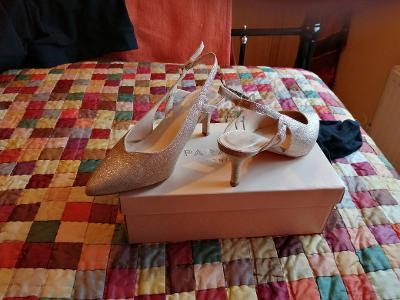
                                 champagne-coloured, glitter-covered, stiletto-heeled slingbacks

Of course, the vast majority of these items are returned to the stores, which in itself is an act that varies considerably in stress-level. Some stores simply include a sticky-backed returns label and a simple form on which you indicate the reason for your return by means of a code number. You then just repack the item in its original packaging, stick on the label and take it to the post office or courier service. Others require you to also inform them by email or via your account on their website, which is a pain if you don’t have an account as you then have to set one up. Sometimes they forget to include the Returns label or the Returns form, or you have to print off your label and stick it to your package with sellotape. And I sent P to the post office so many times when I was giving away my Terry Pratchett books (see last blog post) that he’s considering eloping with the postmistress.

What I have found is that I am much more likely to buy from a store which makes it very easy to return stuff, particularly if they also make it very easy to buy the stuff in the first place. This is why Amazon is so successful. Once they have your card details, you can buy with a click of the mouse or the press of a finger against a screen. When I was young, the idea that you could buy new books for your Kindle while lying in bed in the middle of the night with insomnia would have been a source of fabulous wonderment. It is incredible, really – and horrifying too – that, if you have a sudden yearning for a biscuit tin decorated with an etching of a 1920s Orient Express, you can probably buy it while sitting on the loo in your friend’s en suite. I hate the fact that Amazon pays so little tax and puts so many people out of business – but, boy, is it convenient!

I’ve had problems with delivery people who don’t understand what a bin-shed is, or who leave parcels on the doorstep – we live on a main road and such parcels are ripe for pilfering. But I have to say that so far none has gone missing. I’ve also been refunded all the money for items I have returned, thank goodness – though every time I return something, I get the nagging suspicion that I’ll never actually get the money back. I am in fact deeply impressed by the efficiency of courier services and the Royal Mail – you don’t realise how great they are until you have to use them a lot. The email and text messages online companies send can be weird though: I recently had one telling me that the ‘first package’ in an order was on its way, which alarmed me as all I’d ordered was a mattress topper!

So where am I now with regard to The Wedding Outfit?  In a perfect world, I would be intending to wear the beautiful midnight-blue velvet wraparound dress I bought (online from Bombshell) two months ago, but I don’t live in a perfect world. The dress just about fits me, as the wraparound design gives it some flexibility, but it would definitely look better if I lost weight. The neckline is a bit too plunging, so even with the ‘body-improving’ underwear (bought online from M&S), including the push-up bra, I would still need to pin it together to avoid an embarrassing nip-slip. Incidentally, I was quite impressed by my decolletage in the push-up bra – the bra might be extremely uncomfortable, but feeling like someone is trying to saw through your rib-cage is a small price to pay for suddenly having an eye-catching bosom! 

I tried the dress on the other day with the glittery champagne-coloured stiletto-heeled sling-backs I bought (online from Paradox) and it was the right length and, from the front at least, it looked pretty good. However, from the side and back I looked like one of those cottage loaves made from two fat rolls of bread (the smaller one stuck on top of the larger one).


There is no way I’ll lose enough weight by 21 December to make a useful dent in that blubber, sadly. I lost two stone last year, after learning I was pre-diabetic, but I have gradually put most of it back on over the summer this year. A month ago I went back on the diet and I was very strict – for a fortnight I ate three small, low-calorie, low-carbohydrate meals a day, and I felt hungry constantly. At the end, I weighed myself and I’d put on 7lb!!! This was so depressing that I immediately gave up! The ‘giving up’ coincided with a two-day trip to Northumberland, our only holiday since 2019, during which we spent most of our time in restaurants and teashops due to the permanent heavy rainfall (we’re rain-gods – we have had summer holidays in Cornwall during thick fog or thunderstorms), so I ate too much then.


                                               Alnwick beach, Northumberland, late October 


For the past fortnight, though I haven’t exactly been stuffing my face, I haven’t exactly been cutting down much either. I weighed myself yesterday, out of interest, and I’d put on a further 5lb! So, if these scales are to be believed, I have become 12lb heavier during the past four weeks while either dieting strictly or eating a modest amount of food and an occasional treat. I admit that I haven’t done much exercise during that period, but I still suspect the scales just aren’t working properly!

Anyway, if I’m not going to wear the blue velvet frock, I need an alternative, so I’ve gone back to my original idea of wearing a trouser suit of some sort. I have decided on navy blue trousers and top and an ivory jacket. I bought the jacket (John Lewis online) some time ago – it’s one of those floaty loose-fitting things which are longer at the back than the front and don’t fasten, made of chiffon or some such. They look great on tall, willowy models in photos but not so good on short, fat women, but needs must. After many, many online purchases and returns, I have three pairs of potential trousers – one has a chiffon over-layer so it looks dressy, one is a kind of crepe material and the other is a bog-standard M&S pair in a thin material. They are all too long so need shortening.

Buying the top has been a nightmare, however.  Many places claim to have perfect-looking tops but then it turns out they only have one size 8 in stock. I’ve bought several which only go up to the size below what I really am, but which I have bought on the slim chance that a miracle will occur and I’ll fit into them or maybe they’ll be made slightly big. All of those have had to go back, though I kept one which I thought might be nice if I did lose weight (ha!). I even bought a sleeveless navy-blue vest made out of t-shirt material to wear if all else failed! I have now ordered a navy blue chiffon top from Evans which, if it ever arrives, should look appropriate – I’ve ordered three sizes to ensure one fits! The ivory jacket would look better if it was a thicker material, but I should at least feel comfy in this outfit. It looks much like what I wear for work! Except that, not being a drag-queen (if only I looked that good!), I don’t wear glitter-covered stiletto-heeled slingbacks for work.

So, visualize this: I’ll probably be wearing navy-blue, loose, dressy trousers with a loose, navy-blue sleeveless top, and an ivory floaty jacket. I’ll be carrying a bouquet of blue and white flowers (blue thistles, white roses, eucalyptus leaves, apparently). I’ll be wearing the aforementioned glittery champagne-coloured stiletto-heeled slingbacks. I’ll be having my hair ‘put up’ in some fashion by the nice hairdresser I mentioned in a previous post and I have two ‘hair vines’ (one with gold leaves and tiny pearls on it and the other with larger pearls) which the hairdresser thinks she will be able to twist together and thread through my hair. I’ll be wearing drop earrings with three pearls on them, and a necklace consisting of several strings of pearls loosely twisted together. And I’ll be wearing make-up and a new pair of glasses which I am collecting next week. So I should also be able to at least see what’s going on, having recently had a long-overdue eye-test.


I won’t look great. I’ll look like a short, fat woman in her fifties who is trying hard, but who should have lost more weight by now. But speaking as someone who has been having sleepless nights thinking about what I’m going to do if I can’t find anything to wear, I’m just grateful I have something halfway presentable.  Though I love the shoes (my niece took one look at them and asked drily if I was channelling Dorothy, but I ignored her), I haven’t worn heels for about two decades so I will be at serious risk of falling over.  As you know, I am prone to falling over at the best of times. In fact, I had another of my ridiculous falls very recently, this time right outside my front door while I was attempting to creep up on P (who was unlocking the door with his back to me). That’ll teach me to be childish! I jarred my side and sprained a couple of toes, but – much worse – I’ve cracked the screen on my mobile phone which was in my hand when I fell. Let’s hope that I can avoid falling down the stairs at the Town Hall – I’ll have to use P and our MC, Dave, to prop me up as I walk.

Now I’m just going to have to spend my sleepless nights worrying about the various stupidly time-consuming ideas I have had for place-settings and favour bags…


Thursday, November 11, 2021

Book Review: A writer's opinion


Wilkie Martin:

The Inspector Hobbes ‘Unhuman’ Series

 I first came across Wilkie Martin’s ‘cosy detective’ books a few years back when the first in the series was recommended to me by Goodreads, based on my previous reading. I have to say that, though I enjoyed these books, they clearly didn’t make all that big an impact on me as, when the most recent one came out, I couldn’t remember whether or not I’d read the one immediately before it. I went back to that one on my Kindle and read the first chapter but I was still unsure so I went back to the one before and read the first chapter of that. That rang a very faint bell, so I decided to start from there. Eventually I realised I had read books three and four before but I’d simply forgotten virtually everything about them! This doesn’t really suggest they are particularly inspiring, does it? However, I enjoyed reading them a second time and it allowed me to read the new episode confident that I was up to date with the ongoing adventures of the hapless Andy Caplet.


Set in the sleepy Cotswold town of Sorenchester, the stories are narrated by young Andy, who is a reporter on the local newspaper when the first book opens. Andy is incompetent, accident-prone and generally something of a loser, but his life improves considerably after he meets Inspector Hobbes. Hobbes is, we eventually learn, an ‘unhuman’, along with one or two other inhabitants of Sorenchester, though what precisely this means is unclear. He has certain unusual abilities, such as extraordinary physical strength and agility, and certain unusual habits, such as his fondness for chomping up animal bones when he is stressed. He also appears to be extremely long-lived and has been a police officer in the town for several generations. Hobbes is a wonderful character – he is quiet, calm, extremely good at his job, insightful, kindly and irreproachably decent, honourable and brave.  And he seems to see the potential for these qualities in Andy, which is why he takes him under his wing.

           After becoming homeless, Andy moves in with Hobbes and his elderly but extraordinary housekeeper, an expert in both martial and marital arts, and a woman whose incredible cookery skills engender in Andy a keen interest in food which results in him eventually becoming the food critic for the local newspaper. Hobbes and the housekeeper become surrogate parents for Andy, whose own parents are awful, and Andy becomes much more successful and develops many of the traits of his peculiar mentor as the books progress. He even meets and marries the woman of his dreams.

           The novels are sweet and gently funny. Andy resembles the warm-hearted catastrophe-magnet characters played in old films and TV series by comics like Norman Wisdom, Abbott and Costello, Charlie Drake, Michael Crawford and Jerry Lewis, but the novels are set in the (roughly) modern world. The humour generally works and I have been known to chuckle out loud while reading them, though it usually raises a smile rather than a belly laugh and sometimes you just want to give Andy a good slapping, quite frankly. Nevertheless, he is an endearing character, though I think it is surprising that Hobbes and Andy’s wife are so patient and forgiving with him. As the tales are told by Andy himself, the reader is put in the position of seeing events through his naïve and rather stupid eyes. Such an obviously unreliable narrator stretches the reader’s suspension of disbelief at times, but the novels are so quietly charming that I found myself just going along with the silliness and generally enjoying it.

           These aren’t high-brow novels and they won’t appeal to readers who like fast, hard-hitting action or hard-boiled detectives. They are gentle, enjoyable stories about characters who are mostly pleasant and decent, and who fight against injustice and intolerance in a comforting way. It is a bit like Midsummer Murders but with added supernatural seasoning.


RATING: Inspector Hobbes series ***


Interesting fact: Wilkie Martin is having some success with these charming, if undemanding, tales, and has written a recipe book spin-off of dishes that Inspector Hobbes would enjoy.