Friday, August 5, 2022

BOOK REVIEWS: What I have read since the last review on here

 The Invisible Life Of Addie LaRue by V.E.Schwab


This book is one of those fantasy novels that takes a particular idea and explores what would happen if… 

It is similar in this respect to the wonderful Perfume by Patrick Suskind, which considers the life of a young man who is born with a superhumanly sensitive sense of smell. Another writer whose work does a similar thing is Catherine Webb, an excellent writer who writes science fiction under the name Claire North, including The First Fifteen Lives Of Harry August which is about what would happen if someone kept dying and then being reincarnated with all their memories intact [a similar idea to Kate Atkinson’s Time After Time]. Another of Webb’s novels as Claire North is Touch, about what would happen if someone could find themselves inside another person’s mind, taking on their memories and personality, every time they touch someone. Catherine Webb’s novels are, like V.E.Schwab’s, beautifully written and wildly imaginative, and I will probably review them another time [she also writes YA fantasy under the name Kate Griffin].  

Frances Hardinge is another excellent writer who does this sort of thing. For example, in her novel A Face Like Glass, her protagonist Neverfell is the only person in Caverna who can express her true emotions in her face. In A Skinful of Ghosts, Makepeace Felmotte has the ability to see and absorb ghosts. These ‘what would happen if…’ novels have become a genre in their own right in recent decades, and the best of them are superbly written. Hardinge does more than simply imagine ‘What if?’, however – she also explores historical or imaginary worlds…but I’m not here to review her books at this moment.

At the beginning of Schwab’s novel, Adeline LaRue is an eighteenth century child living in a rural village in France who dreams of escape, of a life more interesting and with more possibilities than her actual life contains. Addie is an artist, and she daydreams about a handsome lover, whom she draws. Then – her life’s inevitable dull, restricted pattern drawing ever tighter round her – she foolishly makes a pact with a ‘god’ who talks to her in the form of the handsome young lover she has imagined for years. She says she will eventually give up her soul if she can first have freedom, immortality and eternal youth.

As everyone who has ever read a fairytale knows, you should always word your wishes very carefully as supernatural beings are very tricksy. Addie’s wish is granted and she finds herself an outcast. No one remembers her after she leaves their sight, even only seconds after they’ve been talking to her. Her own friends and family don’t recognize her because they’ve forgotten about her. In the harsh century in which she was born, she finds herself having to resort to theft and trickery to survive. She travels to Paris, the city she dreamed of as a child, and is forced into prostitution just to stay alive. She never gets thinner or becomes ill, though she experiences the pains of starvation and injury. In her first winter on the streets of the French capital, she falls asleep in the snow, ‘dies’ of hyperthermia and is actually picked up by the cart taking corpses away and flung in with the other dead bodies, but she awakens and escapes this horror. However, over time she learns how to live in her peculiar world, even though it is a depressing kind of life.

The novel jumps from chapters which describe her early experiences to chapters which describe her modern-day experiences, as Addie is of course still alive in the 2000s. She falls in love with men who fall for her, but they can’t remember her once she leaves their company so these relationships have to restart again and again. The god of darkness who granted her wish becomes her lover for a time but she continues refusing to give up her soul despite his frequent requests. She learns that she can influence people – artists, composers, writers – even if they don’t remember her.

And then she meets someone who can remember her.

This idea is not original but Schwab is a fine writer who generally knows how much to tell and how much to show. The jumping around within the narrative is easy to follow and actually made the book more interesting, I thought, particularly as Schwab begins to weave in a contemporary story of another character, Henry. I would add, however, that – in the same way that the pleasure of eating lots of Pringles eventually wears off –

reading this beautiful prose does eventually become slightly tedious. This is a long book, and a more varied tone might help to alleviate the occasional patch of monotony. A little more paring down here and there would speed up the pace, though on the other hand the slowness of the narrative does give the reader a taste of Addie’s own experience as she lives on century after century.

This is definitely a literary fantasy novel, and will not appeal to those who require their stories to be fast-paced, eventful and full of action. Things do happen all the time and the reader gets increasing understanding of the challenges of Addie’s essential tragedy, but the writing focuses on emotions more than events, and probably lingers over descriptions more than some readers might like. I personally found it mostly enchanting though there were places I found myself wanting to skip forward. The exploration of what life would actually be like if Addie’s wish was granted is fascinating and makes interesting points about life in general (as well as warning us to word our wishes very carefully indeed).

RATING: **** [Recommended]


Amongst Our Weapons by Ben Aaronovitch


This is the most recent of the Rivers of London series which narrate the adventures of charming magical detective, Peter Grant. I have reviewed these books before, but I thought I would write a few words about this latest one as this blog is partly a record of my reading.

I enjoyed this instalment and found some of its ideas very imaginative and exciting, though the police procedural element to the stories is beginning to bore me slightly. The real strength of these novels is Peter himself – he is humorous, clever, resourceful, modest and entirely likeable. Earlier novels in the series had more of a sense of modern London in all its grimy complexity, though we do visit the London Silver Vaults (a setting in Sarah Painter’s Crow Investigations series too) and find out quite a lot about the Spanish Inquisition.

The section I enjoyed most was when Peter and his gruff northern superior, Alexander Seawoll, leave the capital to investigate firstly in Manchester and then in Seawoll’s hometown of Glossop. It was fascinating to discover more about Seawoll, and Peter has some intriguing experiences up north. However, I felt he seemed more like a fish out of water in Foxglove Summer, when he left London for an investigation into child abduction on the Welsh borders, than he does in Lancashire and Yorkshire. Much as I love London, it’s always nice to see Peter leaving the familiarity of the city.

Another significant event in this book is that Peter’s twins are born. Peter begins his paternity leave at the end of the story. The story also includes some appearances by Peter’s old friend/nemesis Lesley May. Despite these features, however, it seemed to me like a rather run-of-the-mill episode in Peter’s ongoing story – perfectly entertaining and definitely not one to miss if you’re a fan of the series, but not among the best of them.

Aaronovitch has done something very enterprising with this series – he has published short stories, novellas, and even graphic novels which expand the story outwards. Some of the stories focus on Peter’s teenage niece, Abigail. One novella is even set in Germany and follows Peter’s German equivalent through a murder case. This is all clever and ingenious and imaginative (Aaronovitch wrote for Dr Who), but for those of us who read these books on Kindle, the graphic novels are inaccessible. Personally, I much prefer a straightforward story in words, and I know I’m not alone in this. The upshot of this is that some of his fans feel increasingly cut off from the bigger story of the Peter Grant universe. The novels sometimes contain references to events or characters from the graphic novels.

Nevertheless, the talking foxes are appearing increasingly often in the novels, which is always a good thing. I mean, who doesn’t love a talking fox? 

Rating **** [recommended]


Emotionally Weird by Kate Atkinson
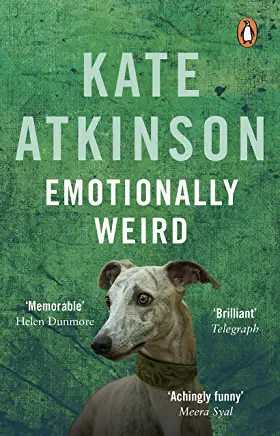


Published in 2000, Emotionally Weird is Atkinson’s third stand-alone novel and I have read some mixed reviews of it. Many people seem to find the ending a disappointment, for example. I read it because it had been sitting in my Kindle library for several years, forgotten and forlorn, so I thought it was about time I gave it a go. I have to say here and now that I absolutely loved it. I found it gripping, extremely funny, highly entertaining, and I wasn’t in any way disappointed by the ending.

              The novel is a work of metafiction, but before your heart sinks let me add that it is by far the most enjoyable work of metafiction I’ve read. It is a novel about novels, about writing and reading. If you are expecting a conventional tale written in a conventional way, you will be disappointed, but nevertheless it still has all the fundamental properties of a complete narrative without one of those ‘Oh, look how clever I am’ endings so beloved of (dare I say it?) male writers.

              Atkinson displays her writing talent throughout by including numerous different genres. The main story, narrated by Effie Stuart-Murray, the protagonist, is a deft comic novel, specifically in the subgenre of ‘university novel’. Yes, it is reminiscent of David Lodge and Malcolm Bradbury, and I’m sure this is intentional. Atkinson portrays a vivid and very funny 1970s University of Dundee, with a full cast of sleazy and/or incompetent lecturers, self-centred feministas, and lazy pot-heads. She is funnier than Lodge and Bradbury, in my opinion. She throws in a few mysteries – the elderly and sweet Professor Cousins thinks someone is trying to kill him, there’s a missing dog, a peculiar private eye, a sinister woman who appears to be following Effie. There are also touches of other genres within this comic novel – suicide, unwanted pregnancy, outlandish accidental death, near-drowning, child neglect, dog-napping, loneliness, and a handsome bad boy with no discernible personality.

The city of Dundee probably didn’t thank Atkinson for her portrayal of it as, in the novel, it is always wreathed in heavy rain, snow, sleet or fog.  

Atkinson deliberately breaks many of the conventions writers are urged to adhere to on Masters in Creative Writing courses – characters will think something and be answered verbally by another character as if they have spoken their thoughts aloud, for instance. There is a massive and ever-growing number of characters, but I found all of them so well-drawn that I still remember the vast majority. Lots of unlikely things occur during a very short period of time. Atkinson introduces magic-realism, and intertwines different genres throughout the story, hints that it will go off in a different direction, so it keeps the reader on his/her toes.

She makes excellent comic use of the conventions of literature – for instance, she highlights the artifice of the story by using the conceit of having this central narrative being told by Effie to her mother, Nora, while they are living on an otherwise deserted Scottish island surviving on oatmeal. Nora, an eccentric woman, frequently interrupts the story to add criticism or encouragement, occasionally to give hints about her own story (a melodrama with the full bells and whistles that entails, though she tells the whole story eventually in an unusually pacy manner).  Atkinson gently satirises the way that in many novels characters tell their own autobiography to another character but do so in a very literary way, not at all how real people would tell a verbal story, apparently remembering everything other characters said, every detail of how the narrator thinks and feels, and sometimes dipping into what other characters are doing when the narrator isn’t there to actually witness them, and now and then changing the story to suit Nora’s criticisms. She gives us snippets from books being written by creative writing students (and lecturers) at the university too, to add to the intertextuality.

              Essentially, this book is like one of those embroideries created to display the different kinds of stitches the creator can do. Atkinson is showing off her multifarious writing skills and making affectionate jokes about the act of writing fiction in all its forms. It felt to me like a humorous homage to writing itself, to the notion of The Novel, and I enjoyed it thoroughly from beginning to end. 

Rating ***** [highly recommended]

Sunday, July 17, 2022


'Night Woods' by Louise Wilford [acrylic]


'Water at sunset' by Louise Wilford [acrylic]

Publication Update:

 My poems 'Shy' and 'Dead Batteries' have been accepted for publication in Bindweed's Winter Wonderland 2022 anthology, published December.

Wednesday, July 13, 2022


'Storm' by Louise Wilford

Writing poetic elegies and eulogies


How to write poetic elegies and eulogies - info, examples, writing task


This is the fourth in a series of articles about different types of poetry. Like it’s predecessors, it begins with an introduction to the poetic form and its effects, including giving you some well-known examples and some websites you can look up for further information. It then moves on to showcase some of my own published poems in this form, and ends with a suggested writing activity for you to try yourself if you wish.


I like the similarity in the words ’elegy’ and ‘eulogy’. An elegy, in Greek and Latin verse, was a poem written in elegiac couplets, a notable exponent being Catullus. These days it means a serious, reflective poem, often a lament for someone who has died. A eulogy is a piece of writing that praises someone highly, particularly following their death. Quite often, elegies and eulogies blur together when we write about the death of someone close to us.

            There is no doubt that events that give rise to deep emotion can also inspire deeply felt, emotionally-powerful writing. Poetry lends itself to the expression of grief. However, in the first aftermath of loss, our emotions are likely to be too raw to allow us to shape our writing into poems that are meaningful to others. Writing can be therapeutic in these circumstances, allowing us to express our intense feelings in a chaotic outpouring that can have the same cathartic effect as weeping. But I have found that the later shaping of that initial deluge of pain can often lead to poems that serve several functions:

A)  1.  They provide me with a personal reminder of the person who has died and how I felt about them

B)    2. They honour the dead, making me feel I have made a public statement about the significance, to me at least, of the life that has been lost

C)    3. They help me to grieve, to come to terms with my feelings – the act of creating a poem in itself is calming and challenging, and it focuses my thoughts onto my memories of the person who has died

D)  4.  Sometimes, they are a comfort to others who are grieving, making them realise the importance of their lost one in someone else’s life


        The pain of bereavement is not always about a human. My beloved cat, Asbo, was euthanised some years ago and I wrote the following poem about the experience:


Last Appointment At The Vet


It was cold as we carried the cat-basket down the path, through the garden gate;

as the basket swung from fence to garage wall, the sleet stuck our hair to our faces;

it was cold and all I could hear was his cry, my knuckles red raw on the plastic grip.


It was cold as we lifted the cat-basket into the car, and we knew we’d be late;

as his quiet cry filled the shadowy space, we shook our sleeves and took our places;

it was cold driving down the salted roads, wiping the tears from our cheeks and lips.


It was cold as we opened the basket, lifting him out, watching his backbone elongate;

he was trembling and quiet, though he still took a stab at grabbing my old bootlaces;

it was cold as we talked to him, stroking his fur from the back of his black ear-tip


to his swaggering tail.  It was cold in the vet’s. She said it was ‘time’ but we still had to wait

til a nurse measured out the right dose. He was held close but squirmed, like all such cases.

Strong hands like clamps round his shoulders ensured that ‘the needle won’t slip’.


It was cold as his eye-lids closed.  I’d expected to feel – not happy, not great,

but maybe relieved. Naively, I’d thought it was kind or brave, looking him full in the face.

They say it takes away the pain, but that car journey home was our longest, coldest trip.


As you know, I only put poems on here that have already been published elsewhere, as I wish to save the others for submission to magazines, most of which are only interested in previously unpublished work.  ‘Last appointment at the vet’ was Commended in the Poetryspace competition in 2019, winning £10 and being included in their Winners Anthology.

        I tried to do several specific things in this poem. I was experimenting with using long lines, and a rigid pattern of tercets where each stanza followed the same rhyme-scheme: abc abc abc etc. But more importantly I wanted the poem to be a record of this intense experience and how it felt, but I didn’t want it to become maudlin or saccharin. I wanted some repetition so I used ‘It was cold’, and here is where the ‘poetic license’ comes in. It wasn’t actually particularly cold that day. It was just raining a bit. But it felt emotionally wintry, and the repetition of ‘It was cold’ felt right to me. When you are writing about real events, you don’t have to be earnestly faithful to every detail. You can begin with a real experience but move well away from it if you wish. In this poem, I didn’t move far away, and I felt I captured the experience truthfully even though the odd detail might be invented, and the use of 'cold' meant I could play with its metaphorical meaning.

            Sometimes, writing about a person’s death can not only help you personally but it can be a public tribute and a farewell, and can be a way of trying to comfort others who are grieving more than yourself.  In 2020, I received a letter telling me that my old ‘landlady’ had died. I put quote marks round the word ‘landlady’ because I didn’t really see Beryl as my landlady, though I lodged in her house for three years when I first moved to London. I saw her as a good friend. We spent a lot of time together and she was very kind to me. I eventually moved out so I could move in with my boyfriend (now, many years later, my husband), but Beryl and I wrote to each other every Christmas between 1993 and 2019, occasionally more often. Though it was the middle of the first lockdown due to the Covid pandemic, Beryl actually died peacefully in bed in her eighties of non-Covid-related heart failure.

            Her death upset me greatly and I could write loads here about her, but that isn’t the purpose of this article. I started to think about things I had done with Beryl when I lived in London, visiting art galleries and the theatre, going for walks. And, while I was walking round Dam Flask Reservoir I remembered the first walk I ever went on with her and the crowd of buttercups we saw outside the church where she is now buried. This led to my writing the following poem:


Buttercups

The card said you ‘died peacefully at home’.

I can’t quite see you tiptoeing away,

without a fight.

                         Today, I’m moving through

a green tunnel, raindrops shivering through pine

and birch to polka-dot the path beneath my feet.

I’m thinking of nothing but the ache in my back,

the tightness in my foot when I step a certain way –

the notes of my mortality.

                                         The forest breathes,

digs its gnarled grey fingers in the rocky soil;

Dam Flask stretches cool across the afternoon.

I’m thinking of nothing but the damp, green

smell, sap pulsing, life pushing out the leaves

and plumping up the purple thistles.

                                                         Then,

I see buttercups outside St Giles’s church,

three hundred miles away and thirty years ago,

on our first walk together to High Elms.

A long, long way from here and now, a life

elsewhere. Tomorrow they’ll bury you in that

churchyard, under the Kentish sky. I hope

they read the Tennyson you loved: Crossing

the Bar.

             You’d have liked it here, old friend.

The air tastes of June and rain. I’m lost

in time and space between the hanging beech

boughs and the bramble. Barbed spines rise

from tangled shadows to stab the sky.

                                                           I hope

your son was honest, not nesting words

in kindly euphemism. You loved that house,

your home. It breathed in weariness

and breathed out warmth. Another life,

a long, long way from here and now. The best

I can wish you is a peaceful crossing. I never

shared your faith – but I shared your hope.

If we must die, let’s have the death

we deserve.

                   Tree trunks, the colour

of mushroom gills, hold up their dark

green bunting in sombre homage. Drifts

of cow parsley follow the crook of the path,

bowed heads mourning. Pallbearer poppies,

red faces cowled by shadow, bend

to their task.

                    Your eyes were speedwell-blue,

skin the pearly cream of woodbine, bearing

as patrician as a foxglove.

                                         Suddenly, three

buttercups are glinting from the shadows,

gold-bright, caught for an instant in the light

that follows rain.  You used to say they stole

a spark from the sun. I’d never seen so many

buttercups as we saw that day, three decades

since, three hundred miles away – such a crowd,

shoulder to shoulder on that August afternoon.


I sent this poem to Beryl’s son, David, as a tribute to his mother. He actually read it out at her funeral, which I couldn’t attend due to Covid but I was very touched that he read it out. It was subsequently published in Pushing Out The Boat, and is one of the most personal poems I’ve ever had published. Beryl loved nature and I wanted to weave her into the landscape. She lived in Kent and I live in Yorkshire, so I wanted to unite my memory of the Kentish countryside with my current familiarity with the countryside of the north east. She loved poetry – we were both fond of Tennyson. I felt that the poem expressed my feelings about her and my memories of her, and I am pleased with how it turned out.

            Some poems about death are very difficult to write (and they can be upsetting to read as they provide a kind of diary entry reminding you of a part of your life that has gone forever). I have written several about the death of my father-in-law, for example, none of which have been published so I’m not sharing them here, which have been very emotionally challenging. The following poem is about a friend of mine who died suddenly, in his forties. I only knew him online, and only for a couple of years before he died, but we became very close during that brief time, sharing a mutual respect for each other’s writing. We helped each other a great deal during the MA course we both did, which is how we met. When two people who respect each other share their creative writing it brings them together in a distinctive and astonishingly intimate way, even if they have never met in the flesh. This is a poem about an unusual friendship and a person I think about frequently even now. It contains several invented, imagined episodes but is true to the reality of our friendship. It was published in Jaden magazine last year:  


You died in the night.


They said you died in your sleep.

But the sleepless nights pressed up against that night

still disagree. The moon kept you awake.

No pain, no buzzing worry,

just edginess. Grit in your eyes.

A quiet ache you couldn’t place.

I see you, through that last dark chain of midnights,

pacing the length of the room,

hearing the wooden floorboards

creak beneath your naked feet,

pulling the duvet tighter round your shoulders,

stepping, aimless, through the cold still air of winter.

You stand at the window, staring

at the spine of hilltops, black beneath the stars,

against the smoke-grey mist of sky.


Hearing the hoot of a distant owl,

an early van on the gravel road beyond the field’s edge,

smelling the snow through the ill-fitting glass,

did fragments of poems drift in and out,

a tide of memory and desire? I wonder – shyly –

if you thought of me,

like on those other lonely nights,

as you paced and sat and pressed your head

against the creased pillow, screwing shut your eyes,

willing yourself to shrug off consciousness.


Wakefulness was always your trial.

Fighting off oblivion.


Your messages still sit on my phone.


How can the world not have you in it?

How many times must I think

‘What would he make of this?’ and then remember

you will never read a word of mine again.

We were two minds in the air, rubbing

up against each other, the beat of shared thoughts.

You were the lapping of waves against the shore,

sucking at rattling pebbles till they shifted,

worn down, worn out.

Sometimes you were a stone bruising the water’s skin.


I’m aching for the part of you I knew.

I’m aching to believe – though I can’t believe –

that you died in your sleep – painless, fearless –

not seeing the cold, white moon through the curtainless glass.


YOUR WRITING TASK [if you wish to accept it]:

1, Think about someone famous who has died, like David Bowie, or a character from a book or film or TV drama who died – Boromir from Lord Of The Rings, say, or Romeo & Juliet.

2. Jot down four or five things about this person/character that you feel would be worth commenting on if you were writing a poetic eulogy about them. These might be achievements or characteristics about them you admire.  Try writing the first stanza of three different potential eulogies – one might be rhyming, another might be free verse, a third might be written in an experimental form such as a shopping list or a list of instructions.

3. Now think about what you would write if you were writing an elegy about this person/character. You might wish to broaden out your thoughts to the nature of death or heroism or honour or weakness itself. You might wish to focus in on a specific incident or memory, or your own feelings about the death you are writing about. Again, try out different forms.

4. Look through the stuff you’ve written and pick out the bits that excite you most. Have a go at developing these into complete poems. You might find they transform into new forms as you progress.

You might find you are able to write an elegy and/or a eulogy (or a combination) about someone you know personally who has died. I suggest you don’t use someone who has died very recently or someone who was extremely close to you, as that might be too upsetting for you. You might choose to write about a pet who died some years ago.  Or you might even choose to write about a metaphorical death – the death of an early ambition, or a relationship that didn’t work out.