Wednesday, November 16, 2022

The Barnsley Experience: a southerner's impression of a northern town

Two of the guests at the wedding reception, Judith Worham and Carole Blacher, as well as being beloved friends, are also writers, and have written a series of humorous and helpful travel guides describing their journeys on the London Underground. Both women live in Kent and ventured up north for the reception, having never visited Barnsley before, so I thought it would be interesting to get their impressions of South Yorkshire for the blog, and they have written a lovely piece below, complete with original photographs. 


The Barnsley Experience


Friday 28th October


Barnsley Market facade


At 4.52 precisely we arrive at Barnsley Station, or Barnsley Interchange as it is now known since they covered it, and the adjacent bus station, with an arcing glass roof and joined everything together with walkways and escalators.  Its an architectural equation (2s + e + g = I),  a most welcome addition to any transport hub where people have to wait for their chosen conveyance during the wettest month of the year.  To be fair, however, Barnsley’s wettest month sees only 5mm more rain than Manchester’s driest and rumour has it that Mancunians flock here in October to dry out.  Our delight at having reached our destination unscathed is enhanced by the fact a couple of fit and friendly young people offer to carry our bags up the stairway from the platform, and a watery evening sun greets us as we step out on to the pavement.

               Judy looks bemused, having no idea where we are in relation to our destination – The Grand Hotel Premier Inn – but I, in true Baden-Powell mode, have printed off a map which indicates that we should proceed along Regent Street to the town hall.  Lacking the breadth and retail splendour of its London counterpart, this thoroughfare has the advantage of being dead straight and relatively traffic free, but is, unfortunately, uphill.  Hardly a mountain, but when you are in your seventies, carrying a bulging rucksack and dragging a suitcase, enough to slow your progress and induce some heavy breathing.  At the end we stop to get our breath back and admire the architectural qualities of this magnificent pre-war municipal building, constructed in a symmetrically classical style of creamy-white Portland stone. 


Barnsley Town Hall


‘Impressive,’ says Judy, gazing up at the central clock tower.

‘George Orwell didn’t think so,’ I reply.  ‘Came here when he was researching The Road to Wigan Pier, and declared that the money would have been better spent improving the housing of the poor.’

‘He was probably right, but nobody ever visited a town and went home singing the praises of the design and provision of social housing,’ Judy observes.

‘It’s like going shopping at Christmas and trying to decide between thermals and furry slippers from Tesco’s or a Stella McCartney Christmas jumper.’

Judy gives me the look, and says:

‘ White stone probably wasn’t the best choice of building material either given that there used to be dozens of collieries around here.’

‘ Bet they’ve had to have had it cleaned a few times.  Anyway, we’ll be back tomorrow to investigate the Barnsley Experience Museum and learn about the town’s illustrious past.’

            We circumnavigate the grand edifice and proceed, still uphill, along Westgate, past Barnsley Sixth form college, a functional, but not unpleasant building, and the back of the Lamproom Theatre, an altogether more quirky looking structure.  Since we are only here for less than 48 hours we will not have time to attend any productions, but this is just as well because we would have to wait until mid-November to see Elf, the musical, a prospect which is unlikely to inspire us to lengthen our stay.

            Ahead of us, tucked between two tall new buildings is the entrance to Gateway Plaza.  Nestling in the corner of this new development, seemingly built on top of a cliff, is the Premier Inn.  Unsurprisingly, the interior looks like every other hotel in this chain, clean, bright, welcoming and totally lacking in any sort of character whatsoever, but, let’s face it, you don’t stay at a Premier Inn for the cultural experience (unless the Barnsley Sinfonia Orchestra happens to be in residence and playing nightly in the foyer).  My room looks down over the Shambles, not a comment on the state of the townscape before me, but the name of the street below leading to the Townend Roundabout.

             Judy joins me, as her room is on the other side of the building and from her window she can only see a hundred or so other windows, and we watch the sun set over Barnsley.  Unfortunately, this is the last we will see of the sun on our trip, apart from a brief rainbow-creation appearance over the Glassworks between downpours.


Sighing as the day slips away in a rosy hue behind a distant housing estate, we decide it’s time for a pre-prandial before dinner at the Little Sicilian (good food, but he was larger than expected and likes to go to bed early.)  Having noticed a nearby hostelry on our way in, we make our way around the corner to the Tin Oyle Bar.  It is situated on the site of the former Barnsley Canister Factory, referred to affectionally as Tin Oyle. This bar pays homage to a part of Barnsley’s industrial past. On display are expertly crafted large cannisters made for Twinings Tea, all in different colours, as well as photographs of the factory and its former staff working. The atmosphere in the bar is happy, friendly and cheerful and the two young, jolly barmen are happy to engage in conversation while making a great G&T.


Saturday 29th October

It’s raining, more of a drizzle than a downpour, but we have waterproofs and our chosen destinations mostly involve indoor mooching.  Having decided to start at the bottom and work upwards, we make our way down Market Hill, turning left at M&S to come face to face with the Glass Works.  The name, an acknowledgement of Barnsley’s industrial past, given to the transformative town centre redevelopment which incorporates a new town square, both outdoor and indoor markets, shopping and leisure space and a Library.  Given that one shopping mall tends to be very much like another, we head for the market in the hope of finding something more indicative of local culture, and are not disappointed.  Stopping only to buy two bananas from one of the brave, outdoor stallholders sheltering under her standard, white, Barnsley Market gazebo, we head for the indoor Tyke bazaar.  I understand that Tyke is a word used to describe people from Barnsley and I sincerely hope it’s an affectionate one, because we have developed a distinct fondness for both the people and the place.  Whoever designed this market had given it a lot of thought. It is clean, spacious and despite efforts to give it a more homogenous, corporate appearance by the standardised use of fonts and stall fronts, each stallholder had obviously taken great pride in presenting their goods in an attractive, accessible and sometimes artistic manner. 


We walk round looking at products and prices. It’s all here: vegetables and fruit, fish and sea food, cheeses, bakeries, a deli, knitting wool and needles, bolts of cloth and pins, jewellery, clothes, flowers, craft activities, pet food, babies’ things, and of course, mobile phone accessories. The most popular stall with a lengthy queue and only one man serving is the pie and cold meats stall.
              ‘Maybe his assistant is having a day off or has gone home injured,’ I suggest.

‘Or maybe he’s attending a cold meats health and safety training day,’ says Judy as we both eye the lethal-looking meat slicer.
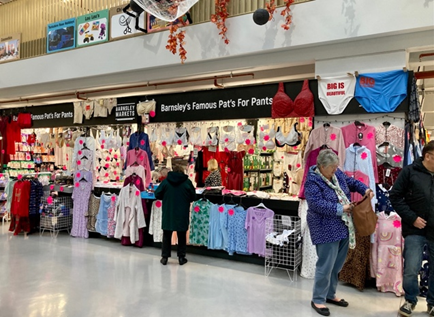


It's underwear and night wear of the substantial, post middle-age variety.  It’s funny how winceyette becomes a more palatable proposition as one ages, even when it is rebranded as brushed cotton – and don’t get me started on hot water bottles.  The display of upper-body receptacles were also designed for the ‘fuller figure’ and put me in mind of Les Dawson’s iconic Cissie and Ada comedy sketches. 

            More in the mood for a brasserie than a brassiere, Judy leads me to the escalator and I dutifully follow her to the food hall.  Now this is truly impressive.  A vast seating area serves a range of food outlets from standard British café sausage-egg-and-chips type menus to more exotic Thai, Indian, Turkish and Italian fare.  All are very busy and manage to cook your order and serve it to your table with minimal delay.  Judy thoroughly enjoys her sausage sandwich even if she has to seek help to open the brown sauce sachet after an increasingly desperate struggle to tear the plastic.  My toasted teacake is similarly tasty and ready prepared with lashings of butter, but an accompanying cup of Earl Grey tea was just too much to expect so, I settle for Tetley. 


Statue of character from Barry Hines' novel A Kestrel For A Knave


Suitably fortified, we exit via the pristine and plentiful Ladies toilets, stopping only to admire the colourful Halloween witches and pumpkins display.  In fact, pumpkins are very much in evidence as Halloween is only two days away and there are pumpkin carving displays and a workshop for children.  Plenty to keep the kids amused while the adults browse and buy.  This place is wonderful – vibrant, colourful and exuding a great sense of community and civic pride, and everyone we spoke to was friendly, helpful and very positive about their new town centre in general and the indoor market in particular. 

              Outside, the rain has stopped, but it’s still overcast and cloudy as we make our way across the new town square past a captivating statue of Billy Casper and his kestrel from the film Kes, and a water feature with little dancing fountains.  No time to linger as we have our sights set on the Town hall and the Barnsley Experience Museum to learn more of this wonderful town’s former glories.

              Choosing a different return route, thanks to my trusty map, we pass through the narrow Victorian Arcade with its passageway of small retro shops, admiring the ironwork decoration and the very different atmosphere.  Crossing the road, we stop at the corner to look at an introductory display of old photographs advertising the museum, arranged around the base of a strange-looking modern sculpture called Crossing (Vertical) by Nigel Hall.  We are not surprised to learn later, that it is locally referred to as the Barnsley nit comb, and wonder if it’s some mutant strain of giant nit unknown south of Chesterfield.  Up the steps, past more fountains, we finally enter the museum.

            Inside, first we sit and watch a screen showing actors playing various characters from the past, dressed in period costume. All perform in the same small room decorated to reflect the times they come from. Beginning in the seventeenth century, it carries on up to the second world war, telling us of their lives in Barnsley, linking them to important historical events. There are things to look at in glass cases, things to touch, films to watch, aspects of Barnsley life on display.  Its industrial past is fascinating, a hive of activity leading to it being a positive hub for trade, so it has long had a thriving market. Barnsley Main is the name of the local colliery that closed in 1965. Its former name was Oaks Colliery, opened in 1824. Thirteen explosions occurred in 1866 resulting in the deaths of 383 miners, England’s biggest ever mining disaster. The shafts were filled in and Barnsley Main took over. This town has a proud but also tragic coal mining heritage and the headquarters of the NUM is still located here

            Sadly, the display about Tin Oyle comprises only a few decorated tins, from the tiny suitcase sort to those with elaborate coronation pictures. The writing about the factory is behind glass and too far away for me to read. We’ve only just missed their display in the museum’s small room to show work from the factory. It’s the same space that was used to advertise the former importance to the world of Barnsley’s balls.  Not a macho boast, rather a surprising fact that the Slazenger factory opened here in 1945. It was, for many years, the sole supplier of Wimbledon’s tennis balls, each one hand finished, and they were given away for free.  On the sporting front we also learn that Barnsley FC, founded in 1887 by a clergyman from his church football team, actually won the FA Cup in 1912.


The current exhibition is of artefacts linked to the life and brief reign of Tutankhamun.  We fail to see the link with Barnsley until we later encounter a lifesize ‘mummy’ trapped in a telephone box further down the road.

‘He must be making a long-distance call,’ says Judy


Feeling so much better informed about Barnsley, we make our way to the Art Gallery in time for a spot of lunch. We’re only just in time.  Judy has long been bemoaning the lack of a decent ham sandwich, so she orders one just to see if the café’s excellent reputation is deserved. It is.

             ‘It’s one of the best ham sandwiches I’ve ever had,’ she says dabbing her mouth appreciatively with the paper serviette.
              ‘Praise indeed given the number of them you’ve probably eaten.  Almost a Which Best Buy,’ I say, sipping the last of my Earl Grey while ostentatiously extending my pinkie.  This is a place of culture after all!
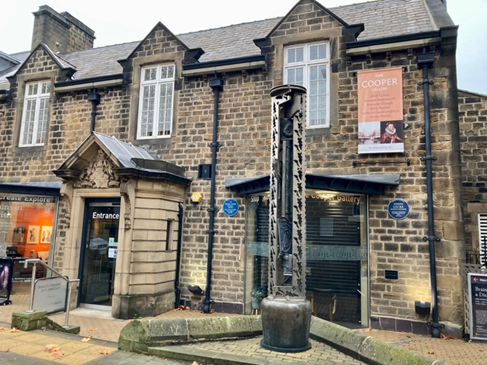


The Cooper Gallery is named after the philanthropist who left his art collection to the people of Barnsley. It houses contemporary travelling exhibitions of modern art, the current one being Brains in a Dish, a display of illuminated molecules showing damage suffered by Alzheimer’s patients.  Upstairs is a large room used for workshops and educational activities, which is currently displaying the boldly colourful work of Sheffield artist, Kate Sully.  In the smaller galleries downstairs, Judy admires the Turner (Joseph Mallord William that is, not Tina) and a marble sculpture of a veiled lady, which is both beautiful and spooky at the same time.  
        It’s a small gallery, but the entrance is free, the café is great and the gift shop sells a variety of cards, art books and, much to my surprise, a series of mugs with Yorkshire slang such as Ey up and Be Reyt written on them.  My attention is particularly drawn to one that says Mardy Bum and I ask the assistant whether it describes someone in a bad mood.  She nods but insists that it is almost a term of endearment.  We are not sufficiently convinced to buy one and settle for a Barnsley fridge magnet instead.  I later discover that the Arctic Monkeys, who hail from Sheffield, have written a song called Mardy Bum which features on one of their alBums.


Sunday 30th October

Even after an extra hour in bed on the day the clocks fall back, we are left with little time for further exploration before we have to say farewell to Barnsley.  The food hall is sadly closed today so we wander down to the Joseph Bramah for breakfast.  A misleadingly small façade opens up into a tardis-like, extensive Wetherspoons on two floors with early drinkers and late breakfasters scattered about the many tables.  The pub is named after a 18th century locksmith and prolific inventor native to the area. He is famous for making a lock that nobody managed to pick for 67 years, also responsible for significant improvements in the design of the flush toilet.  I wonder if Oh, dear, what can the matter be was written in his honour.  A Wetherspoons breakfast is good value for money in any part of the country, but seems all the more enjoyable here.  


We are sad to be leaving and make a fleeting visit to the Alhambra shopping centre, ending up in a sleazier part of town.  But even here there are some wonderful examples of magnificent Victorian architecture such as the old Barnsley British Co-operative Society Building and the grand Public Hall built in 1877.

         After an overcast, but rain-free morning we collect our cases and make our way back to the Interchange.  Barnsley is obviously devastated at the thought of our departure and, as we reach the town hall, it spontaneously bursts into floods of tears, and I do mean floods.  Apres nous, le deluge.  We shelter briefly in a doorway which offers little protection from a South Yorkshire cloudburst, and when the downpour abates slightly, make a bolt for the Interchange, arriving on the drenched side of the wet continuum.  The train to Sheffield is thankfully on time and we manage to find a seat, for it is also pretty crowded.

              ‘It’s all those disillusioned Mancunians on their way back to Manchester,’ I say.

Judy grins as we wave a fond farewell to Barnsley and resolve to come back in the Summer to sample the delights of a sunny sojourn in the land of the Tykes and Mardy Bums.  Maybe we will even get to listen to Barnsley’s wonderful Brass Band and spend an evening in the pub with The Bar-steward sons of Val Doonican, singing The Devil went down t’Barnsley town.

We look forward to it.


The authors:

Carole, Judy and Louise worked together at a college where they wrote a scurrilous magazine called ‘Rant’. Louise escaped to the north, leaving Carole and Judy to pursue their inclination for travel and each other’s company. They foolishly decided to travel along the Northern Line, getting off at each of its fifty stations and mooching about to see what they could see. They saw a lot, and in the process, had great fun, met interesting people and drank a lot of coffee. They have shared their experiences and produced a book which is in some ways a travel guide, and in others just two friends indulging their curiosity. They went on to travel the Jubilee Line and the Hammersmith and City Line.

All three journeys are available from Amazon on Kindle if you search “Down the Tube – Northern/Jubilee/Hammersmith and City Line.”  We only have a few hard copies of the Jubilee/Hammersmith and City Lines left.  Please email us if you would like one at worblerpress@yahoo.com the cost is £10 including P&P.


Saturday, November 5, 2022

BOOK REVIEWS: A writer's opinion of the books she's read since last month

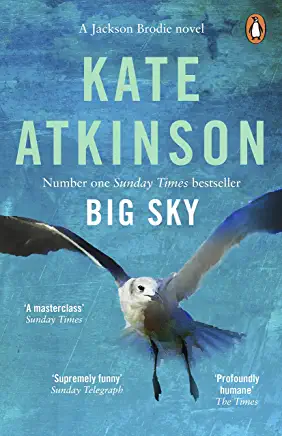
 Big Sky by Kate Atkinson


The fifth in the Jackson Brodie series of detective novels, this one finds Jackson living on the North Yorkshire coast, occasionally with his son while his actress ex-partner Julia films a TV series (about a fictional detective, because Atkinson loves that sort of Russian Doll technique) in the area.

              Jackson Brodie is not really a very successful detective, and Atkinson’s genius is in highlighting his flaws by telling most of the story from the viewpoints of various characters who are directly involved in the current crime du jour, this time a very nasty ring of human sex traffickers. We frequently know much more about what is going on than Jackson himself does, and he stumbles across the crimes often serendipitously.

              Atkinson loves to undermine the detective genre formula, using narrative devices that often teeter on the edge of magic realism while never fully falling over the precipice. In this book, Jackson’s urge to protect the vulnerable leads him to try to save at least two people’s lives before he becomes fully involved in the major crime going on nearby. There are numerous references to events from previous episodes in the Brodie saga, so if you haven’t read them you will find some elements of this novel confusing. There is Atkinson’s trademark humour, her characteristic moments of sly wit or unlikely coincidence. The two young women police officers are called Ronnie and Reggie, for instance, and one happens to have saved Jackson’s life in a previous novel.

              I love all this stuff. As I have said before, I consider Atkinson to be a fabulous writer, though I am increasingly recognizing her stylistic devices. She often has characters thinking something but other characters responding as if the thought has been spoken aloud, for instance.

              What I really love about her work is her ability to create and present characters who are highly distinctive, highly memorable, both intensely realistic but also often so eccentric that they are simultaneously unconvincing. She jumps from character to character, giving us glimpses of the central story from different angles, and she controls the various voices, the different viewpoints, deftly, skipping from one to another with great skill and confidence. And she does it so quickly and succinctly. I found myself really caring about many of the characters as if they were real people – the Polish girls who are rescued from the hell-hole created by the triumvirate of evil ‘businessmen’ at the heart of the story, the possibly gay, sensitive son of one of those men, poor naïve Vince who has no idea about what his ‘golf-friends’ are up to and whose life is slowly falling apart around him. Atkinson likes to break down stereotypes. Beautiful, over-made-up Crystal, once an exploited teen escaping from a brutal care home into an even more brutal world, now the wife of rich Tommy, who treats her like a mixture of domestic servant and sex doll, turns out to be much more intelligent, moral and brave than you’d expect.

              Jackson himself doesn’t feel like the central character in the book. He rarely does. Yet his basic human decency, his old-fashioned sense of what is right and what is wrong, beyond the exigencies of the law itself, his physical courage, his ‘Luddite’ qualities, his awkward relationships with his children and his ex-partners, his loneliness, his love of dogs – well, he is a vivid presence throughout, a thread that holds the narrative in place. Many of Atkinson’s novels feature dogs – her first success, Behind The Scenes At The Museum, was set largely in a pet store. Dogs pop up here and there, as they do in life, plodding through the action, indifferent or confused, often inconvenient. Jackson himself has had a dog in previous books in the series, and was once almost killed by a dog. Here, he is looking after the phlegmatic Dido, Julia’s elderly Labrador, in a novel which also features Brutus, Tommy’s scary-looking but actually very gentle dog, and Lottie, the family dog whom Vince misses more than he does his ex-wife.

Atkinson also creates a wonderful sense of place. The seaside resorts of the north east – Scarborough, Whitby, Bridlington – are brought to life from their sordid theatres and amusement arcades to their majestic hills and beaches. The novel opens with the famous miniature sea battles enacted on the lake at Peasholme Park in Scarborough, and mentions Whitby’s abbey and Robin Hood’s Bay and the gypsum mines and the long coastal path, once a disused train line. For someone like myself who knows the area well, I could taste the salt in the air.  

What can I say? I loved it.


*****  [Highly recommended]


Unraveller by Frances Hardinge


I am a big fan of Frances Hardinge. She writes superb fantasy fiction, highly imaginative, beautifully written, intelligently-plotted. If you like to be taken to new worlds, Hardinge is the woman to guide you. Her stories are dazzlingly original, presenting us with imagined places that are unlike anything else I’ve read, yet they are also, like all the best fantasy, works which are at their core morality tales. They are mostly aimed at a YA audience, as are many of the greatest fantasy novels, but they are sophisticated enough to appeal to older readers.

              This one is about Kellen and Nettle, two teenagers who live in a world where curses are real. Mysterious and sinister spiderlike creatures from The Wild, known as The Little Brothers, give some people the power to curse others. Cursers cannot be cursed themselves, and their curses can only be reversed by a skilled unraveller like Kellen. Cursers cannot be cured, and can only be restrained by being imprisoned in a literally ironclad jail, as iron dampens their powers.  Nettle was cursed in the past, being transformed into a heron by her evil stepmother, but was later de-cursed by Kellen, and has been left with a strange connection to The Wild.

              As you can see, there is an element of the fairy tale about this story. However, don’t let that put you off. Hardinge might weave such ideas through her plots but the intricate details of the characters’ lives, the richness of the worlds she creates, the naturalistic dialogue, the twists and turns of the plot, the sheer brilliance of her set piece scenes and the effortless quality of her ideas draw you in and raise her novels to the top level of fantasy fiction. Winner of the Costa Prize for her novel The Lie Tree, this is not a novelist whose imaginative powers are in any way fading. If you haven’t discovered her yet, read this – she has a large back-catalogue of other equally surprising and equally gripping novels to explore once you are hooked.


***** [highly recommended]


The Thursday Murder Club by Richard Osman


I realise this novel is now old news and Osman has since written several more. I bought it for a friend when it first came out, and I read the first chapter at that time and quite enjoyed the mildly witty style. Osman’s voice came through strongly and I actually thought it was quite entertaining and I intended to read the rest at some time.

              However, the fact that I didn’t get round to it until this year maybe suggests that I wasn’t as drawn in by the narrative as I thought. Also, I joined Audible earlier this year and downloaded Osman’s novel as my first, free, Audible book, so I listened to Leslie Manville reading it, rather than reading it for myself. I thought I’d enjoy being read to, and it was certainly quite a convenient way of keeping myself entertained while doing the housework. However, I can’t say that I was ever completely enthralled by the novel, and I’m not sure whether this was due to the novel itself or to Leslie Manville’s narration.  There was an interview with Richard Osman at the end, I think by Marian Keyes, which was a nice addition for fans.

              Anyway, as a novel, it is firmly in the genre of ‘cosy fiction’ – a bunch of elderly, affluent, middle-class ex-professionals get together to solve a crime. There are red herrings, false clues, unexpected detours, occasional insights into the central characters’ individual lives, unorthodox detective-ing, and a few implausible twists and turns. The characters are a tad stereotypical but generally likeable. It is mildly amusing, poignant in places, and I think I could have worked out whodunnit relatively easily had I been paying full attention. However, one thing I found with Audible is that my mind wanders in a way it rarely does when I am reading to myself.

              Overall, a pleasant middle-of-the-road cosy detective novel which will pass a few hours pleasantly.


***  [will pass a few hours pleasantly and easily, without offering anything more]


Magic Bitter, Magic Sweet by Charlie Holmberg


Charlie N Holmberg is an US author who has written numerous successful fantasy novels. I first came across her when I read ‘The Paper Magician’ and several of its sequels, about ten years ago. She is one of a large number of excellent young female fantasy writers, and I would recommend her highly if you like this genre.

              I listened to half this novel on Audible but I found the American narrator unbearable after a while so I read the last half myself on my kindle. Holmberg has an excellent imagination, original, quirky and enjoyable. This novel is a stand-alone story about a young woman with no memory of her past. Maire is a baker who can instil emotions into her cakes. She can make cakes which make people feel loved, content, excited, angry, whatever. Set entirely in a fantasy universe, the story follows Maire’s adventures which are often very grim indeed, until she finally remembers her true identity.

              Weaving in fairy-tales such as Hansel & Gretel and The Little Gingerbread Boy, and creating at least one particularly creepy character, Holmberg writes beautifully, on the whole, creating a magical atmosphere. I found the final chapters a little tedious, though they are necessary to tie up the loose ends of the plot. I won’t recommend the Audible version as I hated it, but the novel itself is definitely worth a read if you like this sort of thing.


**** [recommended]

Saturday, October 15, 2022

   OCTOBER 2022 

Tales from the first year of respectable married life...

 Judging a book by its cover (or its name)

I don’t think politicians should be judged on their appearance. For example, there are far more important criticisms to make of Donald Trump than his comb-over and the fact that he looks like he’s been tango-ed.  Complaining about Boris Johnson’s hair being like a thinning blonde floor mop or his face resembling a potato simply distracts from serious consideration of his inadequacies as a human being. The fact that someone looks old (Joe Biden), robotic (Theresa May), or like an unhinged doll possessed by a demon (Vladimir Putin) is irrelevant in the greater scheme of things.

‘Good-looking’ doesn’t equate to ‘good person’ and ‘ugly’ doesn’t equate to ‘evil’, though admittedly Margaret Thatcher’s various cabinets were remarkably unattractive.

However, I must highlight one thing about Liz Truss’s appearance. I personally find her face remarkably anonymous, almost forgettable, the sort of face that blends into the crowd. One US TV presenter apparently failed to recognize her at the queen’s funeral and I can sort of see why. She has a great figure, but her face is, to my eyes, the paradigm case of plainness – I don’t mean she is ugly or particularly unattractive, just that her face is so ordinary, so everyday, that it becomes unmemorable.

However, it also has a strange capacity to make elderly people see it as astonishingly ugly, for some reason. My mum says she can’t stand ‘that woman’s face – she has no chin’, even though Truss looks to me as if she has been normally-endowed in the chin department. And my mother-in-law thinks she looks as if she’s had a stroke, though I can’t see that myself. Having said this, my mum-in-law thinks Adele can’t sing (‘She just shouts,’ she claims), so she’s obviously not a reliable judge. An elderly neighbour recently told me she thought Truss’s face looked like a cushion, and a friend told me that her father had described our PM as having ‘a face like a poached egg’ (!!!).

Can the elderly see something we younger people are missing?


Personally, it’s her name that I find more problematic. When I first heard it, I muddled her up with Lynne Truss who wrote ‘Eats, Shoots and Leaves’, so now I can’t help vaguely thinking our PM is a member of the Clear and Correct English Brigade. The name ‘Truss’ suggests ‘trust’ and ‘truth’ (thereby seeming ironic when associated with Lizzie), and also makes me think of my grandma telling me once when I was a child that a man she knew had a hernia and had to wear a truss. I have no idea what a truss is. I imagine a harness of some sort, something designed to hold something up or hold something in….


Afternoon Tea In God's Own County

Two old schoolfriends and myself have begun going out for regular afternoon teas during the past eighteen months. This is a bad thing as one of us is diabetic, and one is pre-diabetic, but we will gloss over that. There is something about an afternoon tea that makes you feel warm and fuzzy, I think – the theatrics of having tiers of goodies placed in the middle of your table by a smiling waitress, the intimacy of sharing the collection of sandwiches and cakes, the peculiar buzz of anticipation as you wait to see what treasures will be included (which is odd because it is usually very much the usual suspects, isn’t it?).

I always wish there was more savoury stuff and fewer cakes. My favourite afternoon teas include things like sausage rolls, mini quiches and pork pies. Nevertheless, I am partial to the one thing that seems to be a certainty on every afternoon tea, which is a cream scone. However, I object to the recent default position adopted by many local cafes which is to warm the scone up. In my view, the only reason to warm up a scone is if it is stale, and a warm cream scone is horrible as it melts the clotted cream. However, as always, I am swimming against the tide on this...

 Our most recent afternoon tea was at a local upmarket Garden Centre, where we were led out of the main restaurant, through a little garden and into a large wooden hut like a very large and very swish garden shed. Here, a smily waitress stood, throughout our meal, as if on guard, close enough to our table to listen in to our inane conversation, which was very slightly inhibiting. It didn't stop us wittering on however. I don't think anything less than a direct nuclear strike could.  As always, we were the last ones to leave the restaurant and all the chairs had been put on the tables in readiness for floor washing, when we did finally wend our way out of the building! 

The service was excellent, though the smily waitress had to bring the tiered plates containing the food from the main restaurant and through the garden to us. It was a drizzly day, so a second waitress had to hold a golfing umbrella over the first waitress as they proceeded through the garden. It gave us something to watch during lulls in the conversation.

One problem we’ve had is that one of our trio is one of those people who are picky with food. At the garden centre afternoon tea, there was a pleasant array of crustless finger sandwiches – cheese, ham, egg mayo, prawn, tuna – but the café had put tomato chutney on the ham sandwiches and Branston pickle on the cheese sandwiches, rendering them inedible to our picky friend. As she won’t allow a prawn to pass her lips, she was left with very little to choose from. Could they not put the pickles in little dishes on the side for those who want them? Some places do that. There was a lovely array of high quality tarts and cakes – miniature cream scones, chocolate mousse cake, bakewell tart, meringues, carrot cake, little cheese cakes in plastic pots – but they hadn’t provided three of everything, which might have led to squabbles, had we been the sort of women who would squabble over a meringue.

Sharing food doesn’t always work well with Yorkshire people. Tapas bars haven’t taken off up here as well as they have elsewhere. Many of us are fussy eaters, which means others have to give up things they like to make sure the fussy eater doesn't expire of starvation. Many of us are hygiene freaks who can’t bear the thought of eating a sandwich that might have been touched by the hand of one of their close friends or family members (you might scoff at this and think I’m exaggerating, but my own mother won’t share a melted camembert or a dish of olives of a sharing platter with anyone. She’d rather go hungry). And if there is a variety of items to choose from, there is always the potential for resentment over perceived unfairness.

My two friends and I, of course,  aren’t at all like this. Other than the before-mentioned fussy-eatership of one of our number, we are delightful models of tolerance, politeness and generous-spirit, who value the scintillating conversation more than the opportunity to raise our blood sugar to dangerous levels.


            But if ever you are lost and have no idea where you are – let’s say you have suffered a bump on the head during a train journey and lost your memory, and are now wandering round the streets of some small grey-stoned town wondering where in hell you have landed – all you have to do to locate yourself is look into the nearest teashop window. If a group of women are yelling obscenities over a tiered set of plates, throwing meringues at one another and flicking Branston pickle at the waitress, you’ll know you’re in Yorkshire…


Wednesday, October 12, 2022

Book Reviews: A Writer's opinion on other writers

 Here are my thoughts on the books I have read since my last book review:


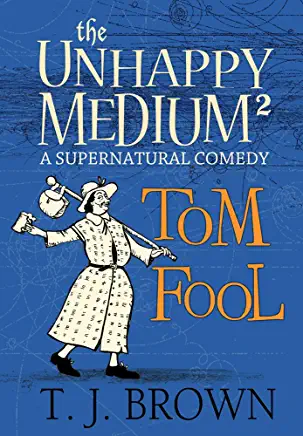
The Unhappy Medium: Tom Fool by T.J.Brown, [Book 2]


I read this a few weeks ago and I've already forgotten a great deal about it, which probably tells you all you need to know. I can honestly say that I enjoyed both books in this series, but they aren't the type of novel that makes you think, or changes your life, or even remains for very long in your consciousness. 

Book 2 is about art theft and some characters from Book 1 reappear. It is mildly amusing, fast-paced, good fun, and it entertained me for a few hours.

*** [passes time in a pleasant way]


White Silence, Dark Light, Long Shadows by Jodi Taylor


This new series by Jodi Taylor has several things in common with her Chronicles Of St Mary's series, as I believe I mentioned in a previous review. I have now read all three of the Elizabeth Cage series, all that Taylor has published so far, and I have to admit that they were page-turners. They kept me awake for most of the night on at least three occasions. However, I am quite easy to please when it comes to mildly comic fantasy set in the contemporary world. 

As with the St Mary's books, the novels aren't without plot loopholes, or at least things you question while you're reading. I can't quite understand why Elizabeth Cage keeps returning to Rushford, for instance, or why she and Michael Jones haven't got down and dirty yet. However, the third book provides answers to several questions readers of books one and two might have, resolving some issues and raising others. 

These books are a bit of a mish-mash of different fantasy motifs, psychological horror, modern mystery and dystopian communities, but they aren't hard-core. There are some scary set-pieces, but it is 'cosy' scary rather than ''hide behind the settee peering out between your fingers' terrifying. The books have an oddly old-fashioned, Hammer-horror, atmosphere. Modern technology takes a back seat. Elizabeth Cage might be a magnet for paranormal activity and weird shenanigans, but she is also a heroine who wouldn't be completely out of place in a 1950s suburb. I quite like this oddness, myself, though I admit it isn't everyone's cup of tea.

Taylor's stories tend to twist and turn, sometimes implausibly, and this series is definitely compelling, if you can suspend your disbelief. We are talking genre-fiction here, guys, however - this isn't literary fiction, and there is a degree of light-heartedness here and there which lovers of horror might not approve of.

**** [recommended]


Shrines of Gaiety by Kate Atkinson


You will know by now that I am a MASSIVE Kate Atkinson fan, and I admit that I haven't reached the end of her latest novel yet so this review is a little premature. However, I thought I would write something here about it, nevertheless.

I'm not keen on the title, and not just because 'gaiety' is difficult to spell. It doesn't quite tell me what to expect - it's a bit vague, a bit melodramatic, despite also being quite apt for a novel concerned with London nightclubs in the 1920s.  This isn't a 'bright young things' novel like Evelyn Waugh's 'Vile Bodies', however. It is about the grimy underworld of post-WW1 London, a world where the ruthless Old Ma Coker and her family run several lucrative nightclubs, notably The Amethyst, and where a spate of murders and handbag-snatching are taking place. This is a world of gangs and corrupt policemen, drugs and criminals, illegal abortionists and missing girls. The Coker offspring's contempt for the 'bright young things' is expressed forcefully several times.

Gwendolin Kelling, a librarian from York, is in London searching for two runaway teenage girls, Freda and Florence. There she meets Inspector Frobisher, tasked with ridding Bow Street of its corruption, homesick for the rural Shropshire where he grew up, and unhappily married to a French would-be suicide driven to drugs and despair by the loss of her child. Niven Coker, Mrs Coker's eldest son, is a man of almost James-Bondian mystery, driving a cream Hispano-Suiza, always accompanied by his German shepherd dog, Keeper. At the point I am at, it is hard to tell whether he is a good guy or a bad one. As always, with Kate Atkinson, no one wears the right coloured hat.  

In fact, the best-selling novel 'The Green Hat' by Michael Arlen is a motif running through the story, and always, along with the 'Bright Young Things' themselves, with a sneer. One of my reservations about the novel is that, at times, it wears it's period research a little too obviously. Atkinson is at her best when she uses her imagination.  One of her characteristic devices is to have characters respond verbally to things that other characters have only thought, not said aloud, which began to jar for me in this novel. Nevertheless it fits with the slender thread of the almost-supernatural that weaves through the story - Mrs Coker's recurring hallucination of Maud, a dead night-club hostess, and her 'reading' of cards and tea-leaves, for instance. You feel that Atkinson is always itching to bring in some magical realism.

My favourite sections were those which tell Freda's story. Despite being a 'stage child', I found Freda an appealing character. Similarly, Gwendolin is compelling too, though she reminds me of Harriet Vane. 

I haven't read the entire book yet so it is unfair to judge it too soon, but it is not gripping me quite as much as other Atkinson books I have read. Her Jackson Brody novels are utterly absorbing, and I love Life After Life and A God In Ruins. I even loved Emotionally Weird, which had very mixed reviews, and her book of short stories Not The End Of The World, which many people I know loathed. Maybe by the time I reach the end of The Shrines Of Gaiety, I'll love this one too - but so far it is falling a little short of my expectations.

14 October update:
I have now read the entire novel and my opinion of it has changed a little. This is, like many of Atkinson's novels, an exercise in exploring the nature of writing itself. As with other of her novels, she uses intertextuality (the amusing excerpts from Ramsay's putative novel, among other things), highlighting the role of artifice and satirising people who think writing a novel is easy. Atkinson shuffles back and forth in time, sometimes describing exactly the same event but from another character's viewpoint, which is particularly effective in what is, at least in part, a crime novel. But it is the ending of the novel which highlights the fictionality of novels most obviously. It is both satisfying and also pared down, with a deliberate feeling that it is being rushed, invented as the writer goes along. The various plot threads come together in often implausible ways, but with a bright fizz of energy as everything is rounded off neatly. Yet the final plot strand mentioned is left open, in an enjoyable way.  This is very self-conscious writing and few novelists could pull it off as well as Atkinson does. 
    
Atkinson's sense of humour glimmers throughout. Frequently, I found myself being deeply frustrated by Frobisher's inability to actually do anything about police corruption or about the spate of murders in the city. He only discovers what the bad cops are up to by being told by another character. He never finds Florence and he finds Freda completely serendipitously after saving her life in a random act of heroism. He is actually  a fairly incompetent police officer, and it is amusing how he always seems to just miss the crucial clue. Gwendolin Kelling, breezy and capable, is much better than him. Their relationship is funny and convincing.  Frobisher's fate too feels like the sort of thing a novelist might do when she doesn't really know how to resolve a situation she has created - there is a deus ex machina aspect to it, but the contrivance feels planned and deliberate nevertheless. Atkinson is playing around with fictional cliches, plot stereotypes, narrative expectations. 

The novel has a strong feminist undercurrent. The misogyny exhibited by many of the men in the book is shocking. This is a novel where the influence of the #MeToo movement is apparent, but where women generally come out on top.

***** [highly recommended - not the best Kate Atkinson book I've read but still up there in the five-star bracket]