Friday, May 30, 2025

READING LIST PREPARED FOR MY MUM BUT YOU MIGHT LIKE IT:

 The following novels are in no particular order but are all books I have read, except one or two, that are mainstream novels generally by best-selling authors. I put them together on this list for my mum, and that is what has limited their range – they are all books I think she’d enjoy. They mostly don’t contain supernatural or fantasy elements. They are generally uplifting by the end. You could look them up to find out more on the internet.


The Rosie Project by Graeme Simsion

This is a moving, funny and ultimately uplifting novel set in the US about a university professor who has no social skills and is probably slightly on the autistic spectrum, and what happens when he meets a very interesting woman. It sold millions of copies internationally. I believe there is at least one sequel.


Lessons in Chemistry by Bonnie Garmus

This was a multi-million copy bestseller when it first came out a few years ago. It is at times shocking, often funny, sad but uplifting by the end. It is the  story of a very clever but socially awkward female scientist in sexist 1950s/60s, who becomes a TV celebrity among other things and breaks down several gender barriers. It was a bestseller, Bonnie Garmus’s first novel, written when she was in her sixties, I think. I thought it was very funny in places and very moving in others.


Mrs England by Stacey Halls

A historical novel about a nanny who moves to Yorkshire to work for a wealthy landowner and gets involved in a mystery.  This is an award-winning Sunday Times bestseller from the winner of the Women's Prize Futures Award.


An Officer and a Spy by Robert Harris

I haven’t read this but it was recommended to me by a friend who loves Robert Harris books. Robert Harris is one of the bestselling authors in the world currently and his books sell like hot cakes. He is incredibly popular. But they aren’t my kind of thing. However, as my mum likes books about spies and suchlike, I thought I’d include it.


Eleanor Oliphant Is Completely Fine by Gail Honeyman

This was a Sunday Times Bestselling Fiction Book a few years ago. It is quite a short novel, uplifting and entertaining, about someone who again has trouble making friends but who has a mystery in her past. During the book, her life improves and she learns how to get on with others.


Tell Me How This Ends by Jo Leevers

BBC Radio 2 Book Club Pick – I haven’t read it yet.


How To Kill Your Family by Bella Mackie

This is an entertaining, outrageous comic novel about a young woman who sets out to murder each member of her awful family. It was a Number One Sunday Times Bestseller.


Starter For Ten by David Nicholls

Nicholls has written lots of bestselling novels but this was his debut, I believe. It is about a young man from a working-class background who goes to university and messes it up. It is funny and realistic. It was made into a film starring a young and lovely James McAvoy.


The Marriage Portrait by Maggie O’Farrell

Instant Sunday Times Bestseller; shortlisted for Women’s Prize for Fiction. I haven’t read this novel yet, but it has been recommended to me many times. It was inspired by Robert Browning’s famous poem ‘His Last Duchess’, and is a historical novel about a young woman who is forced into an arranged marriage with a mysterious and brutal man. O’Farrell is considered to be one of the best contemporary novelists – her last novel was the widely-acclaimed Hamnet.


Molly The Maid by Nita Prose

Uplifting, funny, cozy detective mystery about a young, poor, probably slightly autistic maid in a posh New York hotel who solves a murder. There is at least one sequel.


The Lost Bookshop by Evie Woods

Historical mystery story with a hint of the supernatural – not scary, but a twisty plot set in two different time periods.


A Tidy Ending by Joanna Cannon

A Sunday Times bestseller – dark comedy-mystery. Entertaining.


I would also recommend David Sedaris’s comic memoirs which are very funny – Sedaris is a gay American comic memoir-ist who is the sort of writer you either love or hate – he can be very outrageous. I personally find him hysterical and thinks his writing gets funnier the more you read.

I love anything by Kate Atkinson.


The House Of Stairs by Barbara Vine

Barbara Vine is a pen-name for the crime writer Ruth Rendell, one she used I believe for her more ‘literary’ novels. I haven’t read this one but I have read one or two others by her which I thought were excellent, but I can’t remember their titles. This is a detective/crime story and is scary, I believe.

Thursday, May 22, 2025

Announcement of Jill Saudek's new book: The Mind's Eye

Jill Saudek

The Mind's Eye 


Back in September 2023, the seventh writer showcase I posted on this blog focused the spotlight on Jill Saudek, a poet, prose-writer and, like so many other brilliant writers, a retired teacher. Jill is a fabulous poet and has published two volumes of poetry, both packed with clever, beautiful and thought-provoking poems inspired by other poets. 

        Her first book of children's fiction is published on 23 May 2025, and is an original collection of three long tales each designed to be read aloud to children. Jill began by writing these stories for the younger members of her own family and produced illustrations too, but she noticed that the listening children created their own pictures in their heads. She decided that the book would work better without the illustrations, hence its title The Mind's Eye. These are stories that are rich and complex in their verbal imagery, and they help children use their own imagination rather than constantly being distracted by the contents of social media sites and electronic screens. I am promoting the book here as I think Jill is a fine writer and the book deserves to be read.


Short interview with Jill:

. 

1. When did you start writing?
These stories were written when my various small relatives (nine, in total) reached the age of three and a half - that's now about twenty years ago! I wanted to come back to the stories after the poems were published, as I had a publisher who was prepared to support my work. I used to love creative writing at school, but had composed nothing during most of my adult life as a teacher.


2. You have previously written lots of excellent poetry. What made you decide to write a children’s book? 
It was the joy of reading aloud, watching the children's response as they gazed into the middle distance -  a sign, as I interpreted it, that they were indeed using their mind's eye.

3. Do you think you will ever write prose for adults – a novel or memoir or whatever? 
I have written my autobiography as well as memoirs of both my parents, but these would not be for publication. I wanted to be as honest as I could be in my account of my life and relationships so, from the start, the writing was designed to help me assess my character truthfully and to chart patterns in my life; readers would impede these aims! I have shared my parents' memoirs with my siblings. I find the idea of writing a novel for adults daunting - I haven't found an original subject or approach...but I shall keep thinking of one...

4. What is different about The Mind’s Eye from all the other children’s books on the market?  Why do you think it is worth buying? 
My belief is that the unusual lack of illustrations allows children to develop their own imagination (their image-creation power) - too often this is pre-empted by the ubiquity of pre-packaged images on screen (for example, in the way Disney has taken over the traditional fairy stories) or indeed in most children's books, where glorious pictures dwarf a slim text.  I also found that young children could easily follow lengthy texts - each of my three stories is about thirty thousand words, divided into short chapters - with vocabulary and sentence structure that are more ambitious than I had originally thought possible. Soon, to my delight, I found that the children used the characters and ideas in their own imaginative play.  I also believe that the relative sophistication of the language provides a strong foundation for children's later independent reading.

5. How many books have you had published so far? What has the experience been like? 
I have had two books of poems published. I very much enjoyed introducing the poems to small groups in local libraries or U3A groups, but otherwise I find the business of marketing and self-promotion very difficult!

6. How much time do you spend writing? 
I write quickly so it seems as if very little time has passed, as the words seem to flow easily.

7. What is your next writing project and have you started work on it yet? 
I am waiting for a new idea to strike me! 


Copies of The Mind's Eye can be bought from mainstream bookshops or from the publisher:       orders@austinmacauley.com

Jill's new website address is www.saudek-poems-and-stories.co.uk


Watch the following YouTube video for more information:

https://youtu.be/Ovs12e2UbeY?si=Q2ipfhcn2jg78Y_s 


*

Tuesday, May 20, 2025

PUBLICATION NEWS

 My poem,  'Now You Are Old', came third in the Fosseway Writers' Poetry Competition 2025, and another poem I entered, 'A Funny Turn',  was Highly Commended. The theme of the competition was 'absence'.


Now you are old


Now you are old, he can see the vacant

hollow in your mind, where chemicals

once leapt across synapses, each thought

an electric eagerness. But now,

though restlessness still shambles 

through your senses, the world

cannot stick in that lost space.

Act, respond, remember – all washed up

like froth on listless waves.


You can’t recall the siren pain that

brought you here, imprisoned you in A & E

for eighteen hours, laid you on an unfamiliar

bed, inside the empty tangle of an

unknown room. ‘I didn’t know I had Covis,’

you say, voice faltering with surprise

on the mobile phone. ‘It’s Covid, mum,

and it’s me who has it. You have gall-stones.

Don’t you remember?’


But the events of two nights ago

are lost in the abandoned streets

of that derelict place, cracked

webby windowpanes, the bones

of dusty rooms and doorways

like open mouths in roofless buildings.

Untethered notions drift and fall,

make random links before they lose their hold

and float off, rudderless.


He perseveres, picks at the knot

of your mind till your thoughts unspool,

a grappling hook caught on an outcrop

of memory, but always there’s the sudden

collapse into broken threads,

deformity of misaligned ideas that shape

your baffling world. The absent place

where dreams no longer pounce and pace,

now you are old. 


A Funny Turn


The first time was late August,

leaves yet to fall but hips and haws

glowed hot and red as garnets

in the greenery. I was on the gravel path

that leads down to the dam, slipping

purple sloes into a plastic zip-lock bag.


It always starts with light, as if the sun –

shadow-slanting through the maize behind me –

had slid inside my brain, fizzing my thoughts

like soda. A tremble in my legs, warm air

like Marilyn above an underpass,

hands fluttering like crazed birds.


And as I fell, that first time, a rook

surged upwards from behind the blackthorn

hedge – rising and rising, into the blue,

followed by another and another, till the sky

was a whiteboard filled with ticks,

growing smaller, higher, sheering off


-    -  a Disney mist – towards the lake.

I can hear their rattle and rush –

before the absence, when the world retreats.

Birds fill my vision with a blackness

like closed lids. And next, a voice – ‘Are you ok? –

brush of a stranger’s fingers on my face.


I didn’t know, had no idea of where I’d been

or who I was. Not even sure of what

I was, as my brain rebooted. Was I grass

or air or a bird’s wing cutting through the clouds?   

I tried to move, felt bruised, abraded by the gravel

that dug its tiny fingers through my clothes.


There was a rush of smells, green and sharp –

and the sound of the ground too close to my ears.

‘You’ve had a funny turn,’ some woman’s voice

explained. Later, when it became a thing

I was, rather than a thing I had, it was an ‘episode’,

once petit-mal but now ‘an absence’.


I think now of the first time I withdrew,

that first undisciplined retreat. In sleep, dreams,

faints, you go somewhere – but I went nowhere,

and its sky was filled with wings.


*

Saturday, May 17, 2025

May's Writing Prompts

1. Unrequited love [This is the theme for the story, not necessarily the title]


2. ‘Suddenly, she felt her feet slip forward….' [you have to include this sentence somewhere in your story]


3. A story with one of the following titles: ‘Strawberry Fair’, ‘The Fairy Circle’, ‘Confidante’ or ‘The Beggar’.


4. Choose ONE word from each of three of the four columns below and write a story which uses all three chosen words:


hideous

chemists

train station

beret

gorgeous

hospital

bus shelter

bowler hat

intellectual

newsagents

florists

top hat

moronic

town hall

airport

flat-cap

anxious

supermarket

cycle lane

deerstalker

relaxed

pet shop

tree-top

trilby

ferocious

television studio

harbour

easter bonnet


*


Monday, May 12, 2025

Mid-Month Musings: MAY

 What are friends for?


I have been thinking about the nature of 'friendship' recently. 

Several decades ago, a friend of mine, hitting his fiftieth birthday, told me that the older you get, the more important your friends become. At the time, I dismissed the idea, figuring that friends were equally important however old you were, and not just for lending you money or looking after your cat while you're on holiday. But getting older certainly makes you understand what friendship means. 

I think most people's 'best friends' are their life partners, and P is certainly my best friend. But a 'significant other' isn't quite the same as a 'friend', is it? Our friends are those people in our lives who aren't members of our family or sexual partners, but whom we like, even love, and enjoy spending time with. There are gradations of friendship, from acquaintances to lifelong bosom buddies. They can be older or younger than you, any gender, any race or culture, people you only meet up with in person once a decade, or people you see most days; they might live far away or next door; you might have known them since childhood or only met them recently. 

There are endless reasons to cultivate proper friendships, from having someone who will join you in poking fun at complete strangers, to having someone who'll always know whether you want the truth or a lie when you ask 'Does my bum look big in this?'.

Below are two recent personal experiences of friendship in action:


Socialising

We spent the Sunday afternoon before the May Day bank holiday this year at the Towers, the Master's majestic residence. 'The Towers' isn't it's actual name, and isn't even the full pretend-name we give to it, but I don't want to give away any clues to the actual address, as the Master doesn't have time for streams of visitors demanding tours. To reach the Towers from the Manor [our own stately pile], we have to drive to a different part of God's Own County - from South Yorkshire to West Yorkshire, no small thing for a Yorkshire person - and the fact that we are prepared to make this immense journey into enemy territory illustrates the warm regard with which we the Master himself.


The Master cunningly disguised as a Greek chef


We had been invited to the Towers to partake in a Greek Feast. P and I, and the Master, have been holding these feasts roughly twice a year for several years now, alternating between the Towers and the Manor, and so far we've had feasts loosely based on Indian, Thai, Spanish and Moroccan food. This time, the Master had cooked a delicious stiffado, which led to a torrent of lame puns, plus several other courses, side dishes, entrees and apperitifs, washed down with torrents of alcohol. The only time I ever drink more than a glass of wine is when we visit the Towers, which is the only reason I'm relieved we only do it twice a year. 

Well-basted with Prosecco, spiced rum [which I added to the Prosecco], Retsina and Metaxa, we had a superlative afternoon, wandering through the Tower's recently-raised sunken garden, admiring the Master's massive peonies and his little ha-ha, reclining in the delightful living room full of precious objets d'arte, and even being allowed inside the Master's private study, affectionately named The Cricketers, where he keeps his Old Masters. I'd been dieting for a week, so was pleased to be able to consume a slice of home-made pavlova as my weekly treat:


So, thank you to the Master for such a pleasant afternoon.  This is certainly one of the things that make friendships so important in life.


Crisis-management

Earlier this year, P was away so I went out for a meal with my old school friends, B and T. We went back to ours afterwards for dessert. T, who falls asleep at the stroke of ten o'clock and rises like a lark at the crack of dawn, went home early, but B hung around chatting until about one o'clock. 

I have to confess that I was getting bozz-eyed with exhaustion well before she stood up and announced her imminent departure - not because I was bored, but simply because I was very tired. I actually love chatting to B into the early hours, and have many fond memories of doing so in the past, but I'm just not up to it these days, like I used to be. I'm hoping I'll get my mo-jo back if ever I manage to lose weight and get fit again. 

In retrospect, this exhaustion was why what followed took place...

I went into the kitchen to wrap up some dessert for B to take home for her husband, and when I returned to the living room, B asked me something and I discovered I couldn't talk. 

Yes, I know. This seems odd, particularly as I usually never shut up. 

I could begin sentences, but not finish them. B asked me a couple of questions and all I could say was 'I'm going to...' or 'I will...' before trailing off into silence, unable to get my brain to work out where the sentence was going. 

As you might imagine, this word-salad - or The Case Of The Vanishing Words - was frightening for me and very disturbing for B. 

'Are you ok?' she asked me, and I felt as if I had no way of responding. I just stared at her blankly, as if she'd asked me to solve Fermat's Last Theorem.

B is a recently retired nurse, so she stayed remarkably calm, sat me down and tried to stop me panicking. It crossed my mind that I might be having a TIA [Transient Ischaemic Attack - also often called a 'mini-stroke'], and when I looked at B's expression I could see that was thinking the same thing, which freaked me out even more! 

In retrospect, I don't think it was a TIA. I think my brain had just fallen partially asleep and the language centres were only partially conscious. This might sound like nonsense, but I have a history of sleep-related disorders like sleep-walking, nightmares, night terrors, dreaming that I'm awake when I'm actually asleep, insomnia and nodding off suddenly at random moments such as when I'm in the car. Last year, P and I spent a few days in Cheshire, and every time we got in the car to go anywhere, I immediately fell asleep - I can't remember anything about the actual travelling we did during the short break. Fortunately, I wasn't driving... 

I have pre-diabetes and fibromyalgia, both of which can cause fatigue and disordered sleep. And I have experienced this inability to talk before, though only with P - I think it just gives him a breather.

Anyway, B insisted on staying overnight. She even insisted on sharing my bed [which sounds much more racy than it was!]. Unfortunately, not expecting an overnight visitor, I had only cleaned the ground floor of our house, so it was just as well that she slept in my bed as the other two beds had no bedclothes on them. Also, though we have lots of spare, clean pillows for guests, I was too addled to remember that P uses a foam pillow that is supposedly good for your neck but feels to me like an instrument of torture - poor B ended up having to use that. 

I was still feeling weird, as evidenced by the fact that B asked if I had a t-shirt she could sleep in and I immediately went up to the top floor, then stood in the attic bedroom wondering what the hell I was doing. Was this our T-shirt department? After a while, I remembered that we don't keep any clothes up there, and returned to my bedroom where I spent some time with the wardrobe doors open, staring at my clothes and wondering what a T-shirt was. I'm not sure what item of clothing I ended up offering B as night-attire - it could have been a feather boa, a baker-boy hat or a pair of roller-skates for all I know.


In bed, I tried to make myself feel 'normal' by doing my usual pre-sleep routine of looking at my Kindle for a minute or so, which B rightly thought was a silly idea though in reality I didn't read any of it, just stared briefly at the screen and then put it down. She tried to calm me down by getting me to do 'square breathing' *, but I couldn't follow the instructions. However, I really wanted to get it right as I felt it was the least I could do, as B was being so kind and her evening out had not turned out as she might have hoped. I can't remember the actual details, but I vaguely recall her saying something like 'Breathe in for a count of three...' and me doing this, then I must have missed a bit because I next heard her say something like '...now breathe in for a count of five....'.  I kept thinking: How long does she think I can hold my breath? Does she think I'm a dolphin?

I must have fallen asleep only seconds after lying down, despite the fact that I haven't shared a bed or even a bedroom with an adult other than P for decades, and normally I'd have felt embarrassed and self-conscious. Poor B, on the other hand, spent most of the night awake. She suffers from insomnia anyway, and was wearing a random item of clothing and sleeping on a weird pillow. I had brand new toothbrushes in my bathroom cupboard but I was too far gone to offer her one so she hadn't been able to brush her teeth. 

And unfortunately I am a champion snorer.  

I know that I snore very loudly because members of my family who have been sleeping in the attic bedroom have commented grumpily on how my snoring kept them awake. Ironically, the only family member who has never complained about it is P, who either sleeps very soundly himself, is too long-suffering to complain or is actually deaf. The following morning, B told me that she thought I might have sleep apnoeia as not only did I snore loudly but I also stopped breathing for extended periods every so often. So she'd been kept away by a sound like a buzz-saw through a megaphone every time I turned onto my back, plus long stretches of my apparently failing to breathe. It must have been one of the best night's out she'd ever had!
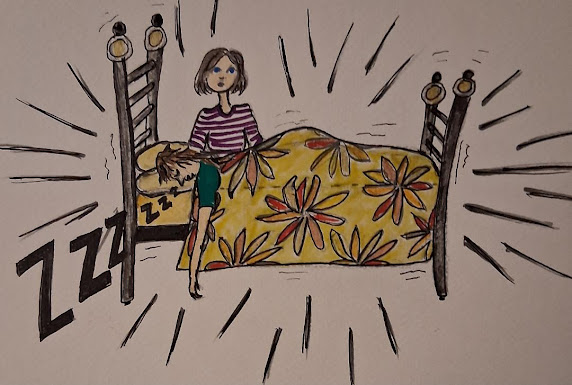


The point of this anecdote is to illustrate what true friendship means. It is not only wanting to chat with your mate till the early hours, but also being prepared to volunteer, unprompted, to stay the night when your friend loses the power of speech, even though it means lying awake with your head resting on a seriously uncomfortable orthopedic pillow, wearing an unspecified but almost certainly inappropriate item of clothing, and listening to your friend snoring so loudly it can be heard in the next street, while occasionally stopping breathing altogether. Then waking up and going home without breakfast, while your friend continues sleeping in bed.

The only time I can remember someone other than P or my mum going above and beyond to help me like this was when another friend, D, with whom I shared a house between leaving university and starting teacher-training, looked after me when I had a very nasty tummy bug. She, like B, went well above and beyond the call of duty.

SO, THANKS TO B [AND D] FOR BEING TRUE FRIENDS.

[And, B, I know I've apologised before and will no doubt do so again, but I'm really sorry about abandoning you, forty years ago, at that awful pub in Sheffield when your car broke down on the way to the theatre...]

 
* Box breathing, also known as square breathing, is a breathing technique that can relieve stress and reset the mind and body after a stressful situation. The technique works by slowing down the breath and distracting the mind by drawing the focus to a 4-4-4-4 pattern of inhale, hold, exhale, hold.
https://www.verywellhealth.com/box-breathing-8423967


What's the best thing a friend has ever done for you, or the worst thing you've ever done to them?