Sunday, April 24, 2022

Writing ekphrastic poems


The following is the first in what I hope will be an occasional series of articles about specific poetic forms, providing a showcase for some of my own published work:


I love ekphrastic poems. The reader gets both the impact of their original subject and the additional layers of meaning and emotion provided by the poet, two for the price of one. I have, nevertheless, heard criticisms of the form that claim that, like the ouroboros, it is simply an example of a kind of solipsistic device, art preying on art, by its nature unoriginal, circular and incapable of moving forward to new things.

However, all artists know how crucial the work of others is to their own. In a broad sense, there is no writing of any worth that doesn’t arise out of all the other writing to which the writer has ever been exposed, all the paintings and films and sculptures and TV programmes and plays and concerts that have formed the cultural collateral of his/her psyche. We draw on everything we experience in our own creations, and in our lives in general. Most writers know how stimulating specific works of art can be to our own work. And it isn’t just other poets that inspire our own poetry. Works in other mediums, particularly the visual, can be intensely inspirational.

However, a modern ekphrastic poem is not a work vaguely inspired by the work of a particular artist, or even one that simply gives us a word-painting – it is a poem arising from a close engagement with a specific work of art. It seems to me that ekphrastic poems are at their best when they give the reader something more than merely a description of the original work, more than simply a reproduction or a translation - they nevertheless need to be closely engaged with that specific work, and the very best of them create something new, something interesting in its own right. They take what the original has to offer and provide a new insight into its meaning, and/or they expand or adjust that meaning, producing something not merely descriptive but dynamic and original. For ten brilliant, well-known examples, try the website https://daily.jstor.org/10-modern-ekphrastic-poems/. 

The first time I wrote an ekphrastic poem was thirty years ago, long before I was aware of the word ‘ekphrastic’. It was inspired by a painting by Modigliani, a copy of which used to hang on the study wall of one of my tutors at Sheffield University. I always liked this painting so I looked it up one day, years after graduating, and found a poem emerging, one which combined the thoughts I imagined the painting’s subject to be feeling and the thoughts of the university academic (entirely fictional) in whose office it hung [it was published by both OWP and Fire in the mid-2000s]:


Tutorial With Painting

She has a long column of a neck, flat blocks of hair,

over-large superior hooded eyes. Her hands are neatly folded.

What does she think, from her bench above the door -

what does she make of the row of teenage heads below,

pens poised to forge a life for her in biro and A4?


Our tutor sniffs, then asks who painted it. A brutal glare.

‘Modigliani,’  I – nineteen – propose. Heartbeat and sweat.

He frowns. He almost snarls his disappointment, his regret. 

His over-large indifferent eyes dismiss my lucky guess. 

Long necks. Modigliani’s trademark.


He looks a bit like her, the tutor: long neck, hair flat

blocks of colour, somehow dead, as if he’ll, as if she’ll,

vanish when we stop looking, lips still pursed.

‘What is the painting called?’ he asks, impatient. There

he’s got me. There my knowledge fails.


Woman on chair? Lady with hands in lap? Haughty

bitch with sneer? No one speaks. A gap of silence

as the tutor tightly smiles, his version of a victory shot.

What does she think of him,  as she ladies it on the wall, 

her quiet scowl, eyes hooded with hauteur?


I’m sure she’s still there, now – though we are not –

and he still asks ‘Who painted it?’ –  response best left unsaid.

Unless, as long suspected, she now lives with him at home,

perhaps behind a curtain - My Last Duchess – canvas slowly

ageing as he moves inside his head. Perhaps he has a wife


who long since learned not to respond, a daughter

who ignores him when she visits with her friends.


Perhaps he’s gone from teaching now - retired, or sacked, or dead.


I wrote the following during an Open University course I was doing many years ago. They gave us links to paintings and asked us to choose one or two and try to write poems about them. I no longer have the links to the paintings, and I can’t actually remember much about them now, but the poems themselves survive:


Why We Hired A Wet-Nurse

 I didn’t want him.  There. It’s said and done.

So now I’m Snow White’s stepma, Lady M,

Hansel’s witch (without the gingerbread).

Unnatural.  Instincts soured like day-old cream.

It’s what you never say:  I didn’t want my son.


She knows.  Her disapproving mouth is pursed

in outrage as she bathes him, feeds him, coos

him to sleep, wipes up his sick.  I’ve seen her,

dangling on her strings – his wail and whim.

I neglect my duties so she steps in first:


my matron-business and my mother-love. We

fight, but lace and lipstick can’t compete

with her pale lullabying voice.  I took

a lover.  So?  I’m Emma Bovary now –

no desolating passion, just ennui.


I didn’t want him. I had been the one,

and then they looked at him, through my taut skin,

and later, after all that blood and pain,

their gazes switched again. When she’s not there,

we creep into his room and stare.  My son


lies with his eyes clamped shut, after his meal,

mouth slick with milky bubbles, red cheeks fat

as Santa.  I never wanted him.  His tiny

fingers curl into tight fists.  Sleep, sleep, my child,

my son, my little one.  I know how you feel.


 [Published in Tears In The Fence 57, summer 2013]


Hydrangeas

 If I’m honest,


I’ve always hated this room, thought it insipid,

like him – pale, watery walls and furniture

scuffed by boredom rather than life.


I’ve always hated  the large, oblong window

with its view of the large, oblong lawn,

hydrangea-fringed. They’re such dull flowers,


those pale blue globes, like puffed-up

ping pong balls.  That’s how I feel,

inflated til I can’t escape, like a young girl’s


wedding-ring stuck on an old woman’s

swollen finger.  My last bolt-hole blocked

by his child and his affection.  Why did


it arrive now, this note rousing old hopes,

this leftover voice from before I got here?

I’m lost, running through a daydream, clasping


my suitcase, down the dusty lane.  The last train

won’t have left yet.  Imagine the neighbours’

faces, wondering where his wife is going


so late on an October afternoon, looking so

alive.  Not knowing I’m not returning.

But the truth snaps back like a slap in the face.


I clutch the table’s edge, and with my free hand

feel the heavy curve of my belly through the

cotton.  His child and his affection, pinning me


to the room, the cool years elongating ahead

of me.  It arrived too late, this letter, too late to

detonate, ignite the stifling powder of our lives,


hydrangea-fringed – though I imagine the explosion,

insipid petals strewn across the oblong lawn,

glass-fragments on the table, and I’m sorry,


if I’m honest.


[First published in The Interpreter’s House, 2008]


The excellent magazine, Rattle, runs a regular ekphrastic challenge which has inspired two other poems by me, based on pictures the magazine provides. The first one I wrote (below) was later published by Pushing Out The Boat, Issue 16, April 2021. Copyright issues prevent me from including the painting that inspired it:


A walk on the canal path

 Rain on the canal dimples its millpond

lethargy, stirs with a thousand tiny slaps

its sludge-grey sluggishness,


releases the sour-green scent

of algae and nettles. I walk in the dust,

fast dissolving into reddish mud,


feel pebbles itch beneath my boots.

Drops sting the bat-wing webs

of my umbrella, a percussion


of tiny finger-taps that swamps

my thoughts. I’m trying not to think –

trying hard not to think about you –


as I step round sludgy puddles, dip

my head to dodge a dripping branch.

Watch the damp crows circle the disused


factory, broken edges sharp as cracked teeth

– the derelict now deliquescing

into the purple of bruises, November greys,


the rusty ochre of corrugated

roofs. Shadows slide across water,

ghostly slips of light rippling like wraiths


across its putty-coloured surface.

A mirror made of old glass,

casting my thoughts back in my face.


Ekphrastic poems can be inspired by other works of poetry, not just by visual art. One of my own that I have always liked was based on Tennyson’s poem ‘The Lady Of Shalott’, and I like it because I wrote it while invigilating a mock exam. Reading it always takes me back to that afternoon, to the sense of subversion I had because I should have been focusing entirely on policing the students (there were several other invigilators so no one was allowed to cheat despite my lack of professionalism!), and to the strangely comforting silence of an exam hall when you're not sitting an exam yourself - the quiet turning of pages, the almost silent scritch of pen against paper, the ordered gentleness of the experience in the middle of a work-day. I also remember the fizz of excitement I felt as the poem seeped into my consciousness as if out of the ether. In 2005, it won First Prize in the Mike Heywood Poetry Competition and was also one of eight poems chosen in a competition run by the Tennyson Society (it was displayed on the walls of The Mirehouse in Bassenthwaite, Cumbria, in 2009). I subsequently wrote a series of poems based on Tennyson’s work which were later published in Three Drops In A Cauldron, Issue 23, August 2018:


Lancelot's Testimony

I took a different route: the sun glared

at the bright wheat and the barley fronds;

the air swam in a heat haze, licking up

stale river scent and the hot incense of lilies.

I itched inside my armour; my head ached.


I'd heard the reaper's tales, soft-minded rumours

of faerie voices heard at dawn and dusk

when the world settled - still - and sounds carried

over the water.  But the island, willow-fringed,

seemed derelict. Grey stone of ancient towers


peered over the treetops; crooked crenellations

stood, gap-toothed, against the blond, blank sky.

I heard no mystic song, only the distant calls

of market girls and peasants treading slow

to Camelot, and the sly jangle of bugle


against saddle - though there was a dislocated

silence in the atmosphere, as if the air hung

tense; seclusion cossetted the island like

down; sounds slipped, collided, slid off downriver,

edged out. Bird call and hoof against dirt path


were blunt in the brittle heat. I felt like

a bauble melting in the sun, exposed,

a glossy tiger's eye, garish shield blazing,

red and gold; I felt I was pinned, observed,

impaled by a javelin stare. The smell of


horse sweat, white froth on the mare's flanks; acid

taste of heat on my tongue; breast plate cutting

weals in my armpits. But I heard no strange

sighing chant in the glazing noon, no soprano

adagio over the fields. Just the silence,


biting and austere in the dried clay heat.


A few years later, I wrote another series of poems inspired by a work of literature, this time The Tempest by Shakespeare. This play has inspired me to write a short story too, which got my highest coursework mark on the MA in Writing I did a few years ago, so I have a lot to thank The Bard for! One of the poems I wrote in this sequence was published in Dreamcatcher, Issue 38, January 2019:


At Prospero’s Funeral

 My father wept when he left his dainty Ariel

behind. Half-blind with grief, he stood in the stern

of Alonso’s ship, watching the isle dissolve.

Ariel’s farewell breath filled the sails; he flickered

in cold flames along the spars and rigging, danced

like an ape atop the crow’s nest. But all my father

did was weep and stare.

                                        It’s there I see him now,

hands whitely gripping a salt-roughened rope,

his robe becoming watercolours as the island fades.

His old eyes crust with cataracts, spine bends,

nose hooks, cheeks shrink. He looks his age.

No more the mage who raised the dead, controlled

the stir and sweep of the wind, brought goddesses

to earth. 

                 But then, it always was a show - always

the cliff-top pose, cloak billowing behind, staff

raised. The ducal voice. I am Milan. He was a fake,

my bully father.  It was Ariel who could change

for the occasion, slip into a mermaid’s skin,

vanish to a drift of pipe and tabor in the air.


I’d tear the stinking feathers from his harpy’s wings.

I’d trap him tight in the oak’s entrails.  He’d not

entangle me in his foul song, the changeling thief.


My father thought I didn’t know. The mighty Prospero

relying on a  wisp of spirit! Mastering him with a promise.

He never promised me. He turned me off and on.

Fed me to Ferdinand, the sap, to stitch together Naples

and Milan. I was a child. How did I know the world

had such men in it?                                      

                                No, it was his dainty chick, his Ariel,

for whom he wept and stared. I was just his blood.

No good ever came from daughters.  So I watched him,

clung to his words as if they’d raft me home, studied

his ageing face as it corrugated and dissolved.

But it was Ariel he wept for.


WRITING TASK:  Why not have a go at your 

own ekphrastic poem? Find a work of art that moves you in some way and see where it takes you.

BOOK REVIEW: What I’ve been reading recently

 Poems From Paintings by Jill Saudek


Published by Austin Macauley.

Available from Amazon - £3.50 (Kindle), £9.99 (print)


This is an excellent and entertaining collection of poems by a talented writer. The problem with poems written in response to existing paintings, of course, is that the expense of including prints of the actual paintings in the book itself is prohibitive, so readers are encouraged to look them up online. This is well worth doing, as the poems – though many stand up very well on their own – are definitely enhanced by the experience of seeing what inspired them. The result of viewing both picture and poem is that the reader’s understanding of both works is heightened.

Saudek’s writing makes use of elegant and vivid images. In her poem arising from Edvard Munch’s painting ‘Moonlight’ (1893), for example, she writes:


 ‘Now the posts seem stems of silver


  Their cut heads like the frail flowers which quiver


  Fearful, beneath the window’s guillotine’


Such magnificent comparisons more than make up for the occasional slightly creaky rhyme or the odd dip into something approaching cliché here and there. In such a large collection, such moments are forgivable and the reader is well-compensated by Saudek’s gift for imagery.

I was also struck by her sense of rhythm, enriched by a subtle use of alliteration and assonance:


                         ‘The salt dead sea, strewn with carcasses

                           The lowering hills of heat-struck rock, bare, barren,

                           Air becoming fire, terrible silences…’

                                         [Holman Hunt, ‘The Scapegoat’, 1855]


On the whole, she uses rhyme as a subtle scaffold for the verse, often making use of half-rhymes, embedding rhyming words in the middle of lines or eschewing any rigidly formal rhyming pattern in favour of a fluid system where the rhymes appear where they will. Saudek has an admirably light touch with rhyme, on the whole, something which I greatly admire. I think rhymes reach their greatest power when they are elusive, restrained and understated. Saudek is able to confidently use more obvious rhyme-schemes, however [as in Cezanne: Mont St Victoire, C 1905], and to use robust rhymes in a playful way [as in Van Gogh: The Bedroom at Arles, C 1889] – it might be that the paintings themselves, their styles and their subjects, lend themselves to different levels of control.

              In such a generous collection, there is bound to be some variation in quality from poem to poem, but I can say that I have read about two-thirds of the book now, often dipping in randomly, and so far I have seen no serious dilution anywhere. There are some stand-out poems, of course, and their identity will vary from reader to reader.

I understand that, before embarking on this work, Saudek wrote a series of poems based on other poems (which are also going to be published by Austin Macauley, I believe), and I expect these to be equally as delicious and enlightening as this current collection.

Varied, imaginative, often unusual, often poignant, often amusing, psychologically insightful and beautifully written, these poems are a satisfying cornucopia of work to dip into, and their accompanying paintings add an extra layer of delight for the reader.


Rating: ***** Highly recommended.

Tuesday, April 5, 2022

Good news!

 My short story, 'Backwards', has just been accepted by River and South Mag for their Summer 2022 edition!

Saturday, March 5, 2022

Why are TV shows so lazy?

Earlier today, I saw an advertisement in a teashop in Derbyshire for an event coming to Sheffield Arena in June.  It is called ‘The Wool Monty’ and it was this dire pun which drew my attention.  “The Wool Monty,” I read, “is a different kind of yarn show.” Well, I don’t know about you, but I didn’t know there was even such a thing as a ‘yarn show’, let alone a 'different kind' of one, or that it could fill an arena.  Who knew knitting was so popular? The term 'show' conjures up, for me at least, an image of singers or dancers at the very least, maybe a ventriloquist or performing dog, but I guess that's just one kind of show. We have the Ideal Home Show and The Motor Show and The Chelsea Flower Show, which are all basically exhibitions with sales pitches, so I expect The Wool Monty will have displays of different types of yarn, and maybe knitting/crochet/macrame demonstrations. Maybe there'll be a walk-on alpaca or cashmere goat. 

              Then, later, I saw a video on Facebook which began with the words: ‘Make your hallway goals a reality’.  Well, my only hallway goal is to have a hallway big enough for two people to squeeze past each other without having to get married, and the only way I can see to achieve this is to either turn my house into a TARDIS or have an open-plan toilet, and I'm certainly not videoing that. I mean, are ‘hallway goals’ a thing now? Are we meant to have them?

              Which brings me, by a very roundabout route, to my current writing bugbear, which involves another type of 'show' (a US TV show), and another type of goal (to see the writing on such shows improve).  Yes, I realise that the link there was extremely tenuous but I have to fit in various things that have struck me recently and they don't happen to be very well connected! 

        I have been watching the Amazon Prime series Blacklist, starring James Spader, an actor I have long had a secret guilty crush on. If you don’t know, it is a ludicrous show about how the FBI take on a new young female profiler on the same day that notorious, man-most-wanted, criminal mastermind Raymond Reddington gives himself up to them and insists on making a deal: he will let them have a list of names of the most powerful and dangerous super-villains currently in operation in return for his freedom, but he will only talk to the new young profiler, Lizzie, with whom it turns out he has some murky and convoluted connection (though she doesn’t know this). 

            The story becomes increasingly absurd. I’m currently on Season Five and even James Spader’s sinister charm is losing its sexiness and becoming irritating now. For one thing, it is difficult to find a man with chubby features and no hair, who dresses like your well-to-do grandad, particularly frightening, and Red is becoming less and less interesting as his apparent invulnerability begins to crumble and the conveyor belt of super-villains gets longer and ever more outlandish. One (played by the wonderful actor who plays Abe, Mrs Maisel’s dad, in The Marvelous Mrs Maisel) actually had a white cat, though that was a self-consciously comic episode.

              Anyway, this isn’t my beef. The thing that irritates me is the sloppy writing. It is something I noticed when I watched Elementary, the US version of Sherlock Holmes with Jonnie Lee Miller playing our hero alongside Lucy Liu as his expressionless robotic sidekick, Watson. While in many ways these shows have great dialogue – snappy, humorous, unexpected – and, for instance, the disconnect between Ray Reddington’s affable conversation and his sudden bursts of outrageous violence is pretty effective (though this particular schtick is wearing thin), they also have a lazy habit of doing cringeworthy exposition. In a recent episode, for example, during a team-briefing about the latest supervillain (a character inspired by realworld new-tech entrepreneurs like Mark Zuckerberg, Jeff Bezos and Steve Jobs), the person giving the briefing mentions the name of the tech company this blacklister founded. This is a made-up name, but is obviously meant to suggest any of the multi-billion-dollar companies that are realworld household names.

However, because US TV shows clearly think their audiences are cretins, FBI agent Donald Ressler has to then say something insufferably stilted such as ‘What? [Name of company]? The Social Media giant?’ (I paraphrase, as I can’t recall the exact quotation). If they are talking about the extremely famous founder of an extremely successful and well-known social media company, the FBI team would know the name of the company without this asinine ‘clue’. Yes, the information is for the audience at home, we viewers, but surely it wouldn’t be that difficult to let us know in a more subtle way? They could have Ressler reacting with shock to hearing the name of the suspect company, without telling us what kind of company it is, which would tell us that it is supposedly well-known and highly successful within the world of the show. Then they could show us in later scenes what kind of company it is, through what they actually film and through more subtle and natural dialogue. 

But no, they go for the easy, lazy option every time, giving characters ridiculously implausible dialogue simply to get information across to the viewer. As a watcher of the show, this makes me feel like they don’t care. It feels cynical, as if they assume we too just want the plot fed to us with little attempt at realism. Yes, I know this is a show with a completely unrealistic premise and extremely silly plots, but it has some great actors and some great writers, and the audience – loyal enough to hang around for about ten seasons – deserves better.

And this is before I get started on the contrived plot twists and artificially extended quests, the virtually supernatural way that Tom Keene avoids being killed in every episode, the way that injuries heal so quickly and characters are given inauthentic emotional arcs simply to provide a bit more implausible ‘character development’… etc.  I didn’t say it was brilliant, did I? But the first two seasons were at least watchable and entertaining. But lazy writing like I’ve outlined above will ruin this show, as it does so many others. Take heed, my friends.


WHY YOU SHOULD READ NOVELS:

On Facebook recently, I spotted this list of reasons why people should read novels, and I thought I'd add my own interpretations of each point being made:

FACT 1: Reading can make you a better conversationalist

“Have you read The Girl On The Train? No, Oh great, let me give you a detailed summary of the plot, then – and don’t worry, I’ll have to go back numerous times to fill in details I forgot and there’ll be lots of pauses while I try to remember the names of characters, but you’re not to jump in during those pauses as I intend to get right to the end.” 

Fact 2: Neighbours will never complain that your book is too loud

Until you throw your hardback copy of Midnight’s Children at the partition wall in frustration.

Fact 3: Knowledge by osmosis has never been perfected. You’d better read.

I learned everything I know about Narnia and Middle-Earth from books.

Fact 4: Books have stopped bullets – reading might save your life.

Only if they are shaped like a Kevlar vest, or made out of bullet-proof glass.

Fact 5: Dinosaurs didn’t read. Look what happened to them.

They evolved into birds which massively outnumber humans – there are 40-60 birds for every human currently on the planet.

The only reason to read a work of fiction is because you enjoy it. Nothing else makes it worth it.

Except (maybe) in order to pass your Eng Lit exams…


A forgotten prize-winner and an interesting experiment: Stanley Middleton


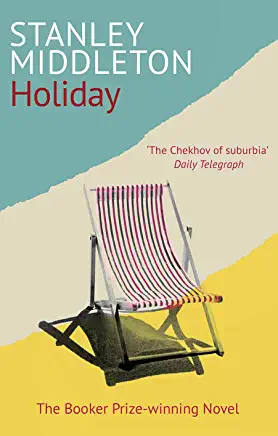
In 1974, the author Stanley Middleton won the Man Booker Prize for his novel Holiday (he was a joint winner along with Nadine Gordimer). Despite this claim to serious literary ability, I’d never heard of him before someone mentioned him on a Facebook site, but I became interested in him during a conversation about novelists from Nottingham (a city only an hour away from where I live).

According to Wikipedia, Middleton was a creative powerhouse – he was a talented church organist and a gifted water-colourist too. He wrote 45 novels, twelve of them before he wrote Holiday. His first novel was published in 1958, the last one in 2010 (a year after his death). He was an English teacher at High Pavement Grammar School in Nottingham for many years. And apparently he turned down an OBE due to believing he shouldn’t be rewarded for doing what he saw as simply his job *.  

I have never read Holiday but it was clearly sufficiently accomplished to be awarded a prestigious literary prize. This was a man of great ability, a man whose literary life was, by most people’s standards, a successful one. Yet I have never heard of him or his most famous novel, and neither have any of the people I have asked.

I tell you this because it has made me think long and hard about this weird activity in which we engage our energies, we writers.  For most of us, whether we are any good or not, and even successful and talented people like Middleton, it is an unrewarding activity, at least in terms of the way most people judge ‘rewards’. Middleton was able to publish his novels, win a Booker and be offered an OBE, but he presumably never achieved the wealth or fame of the handful of contemporary novelists most people have heard of – J.K.Rowling, Robert Harris, Terry Pratchett, etc. Now, around a decade after his death, I suspect that he is generally forgotten, except by those who knew him and those who know his books. Who knows? His reputation might be revitalised in years to come – there have been many creative artists in different fields who were quickly forgotten after their deaths but later ‘rediscovered’. But, for now, Middleton seems to be a relatively forgotten author, despite his success during his lifetime.

Writers like myself, who have had some things published but nothing that has made them any money or given them any fame, would love to achieve Middleton’s success. Forty-five published novels! A Booker Prize! An OBE! Yet most people I speak to who aren’t writers and readers (and that is, in fact, most people) would consider such success to be relatively unimpressive. More obvious worldly achievement is generally better-respected these days (and perhaps always has been) – massive wealth, a name and a face that everyone recognises, books that top the bestseller lists, novels that are picked up by Hollywood and made into movies. There are novelists who have these things even though they are dreadful writers and will probably be forgotten forever after their deaths. There are also, of course, extremely talented writers in this category of the super-successful who will be remembered fondly for many years by many people. But, in today’s publishing world, achieving Middleton’s level of quiet success is a major feat in itself – hell, getting a novel published in the first place is like winning the lottery, and having further novels published if your first one isn’t as successful as your publishers hoped is virtually an impossibility.

In 2006, The Times pulled a stunt that produced some interesting results. They circulated the first chapters of Holiday, and also of a novel by V.S.Naipaul, to numerous agents and publishing houses, presumably using false names. All rejected Naipaul’s novel, and only one agent accepted Middleton’s.  From this, we can assume that publishers in the twenty-first century have different tastes, or know that their readers have different tastes, or are simply unwilling to invest in ‘literary’ novels.

What lessons can we learn from this? Do we give up writing? Is it a pointless waste of time?  I have two thoughts. One is that, if you are a writer, you can’t stop yourself writing – writing is your greatest pleasure (which isn’t to suggest that it isn’t often difficult, painful and stressful) and a writer is who you are, published or not. Earning your living through writing is another thing entirely. The second is that we need to see the rewards of writing, just as we see the rewards of reading, as being different in kind from the rewards of, say, being a solicitor, or a surgeon, or Kim Kardashian, or the founder of Google or Amazon. The rewards are intrinsic, not instrumental. There is something inexpressible that every writer who is serious about their craft has experienced – a feeling of satisfaction in having successfully translated what existed inside your head into something that others can understand if they want to. It is nice if people read what you have written, even nicer if they enjoy it – nicer still if they take the time to tell you they enjoyed it – but, even if no one ever reads it, you still have that profound sense of having achieved something worthwhile, however flawed you feel it is.

The joy of becoming better at something you find intrinsically enjoyable is in itself one of the rewards of taking yourself seriously as a writer. And I’m not even mentioning the myriad rewards of the actual writing itself – the pleasure to be had from putting the best words in the best order, of exploring new worlds, constructing lives, creating characters, getting inside their heads, telling their stories, examining ideas and philosophies and what ifs. The act of attempting to entertain others is profoundly enjoyable. There is a therapeutic quality to writing at times – self-expression, creative contentment – and sometimes a performative element too, a showing off. Few writers are rich and famous, and in fact many barely make a living at all from their writing. Many never give up the day job. But no one would do this activity, which is hard and time-consuming and exhausting, if they didn’t get some sort of deep-seated intrinsic reward.

Some of us might manage to write the novels or stories or poems or scripts that fill our imaginations. Being published, read, performed, admired, or paid – well, that’s the icing on the cake. The sad fact is that most of us are lucky to get even the cake, but sometimes it’s enough just to smell the batter rising in the oven...


* https://en.wikipedia.org/wiki/Stanley_Middleton