Monday, March 18, 2024

Mid-Month Musings - MARCH

 A Room Without A View

Many people decorate their own homes, and many of those people become experts at doing so.

I myself have become pretty adept at decorating, due to years of practice. Admittedly, I’ve only once tried my hand at wallpapering, and it was only one wall – but I did a fairly good job of it. I matched up the complex pattern on each strip of paper and cut out the fiddly shapes at the edges accurately. Unfortunately, the wall I chose was in our bathroom and there was no room for the pasting table so I had to squeeze it onto our very narrow landing. This meant I had to stand in the bathroom doorway to paste the strips of paper, stretching as far as I could [not far] in either direction to spread the paste. For anyone observing, it would have been a bit like watching a Dawn French comedy sketch. The result was that I didn’t put enough paste on some edges, so a few corners of the wallpaper quickly began curling off.

Before you ask, the paper was designed for bathrooms, and, despite having no window, our bathroom is well-ventilated as it has a good fan and we tend to bathe with the door wide open – when there is no window in your bathroom and you live with only your partner and the occasional cat, you get blasé about lounging in the bath, bits on full display [we became less blasé the year my niece and great-nephew lived with us!].

I’ve never tried tiling, but I did do a lot of stencilling in our flat in Greenwich, including making my own fish stencils for the bathroom which everyone who saw them seemed to be impressed by [though they might have just been being kind].


Fish On The Wall 

These are the bream and bass of my half-sleep,
the fish I painted on the bathroom wall
in our first flat, when we were fingerlings,
when I still loafed half-asleep in the soapsuds,
squinting through cave-mouth eyes
at my handiwork.
Moon-pale, or bright as dogwood leaves
swimming through an ice-cream breeze,
they edge close, then dart away
through the green-grey sea.

See the mackerel glide
from a corner’s universe,
stippled like tips of light through railings on an autumn day,
into the steam and soap,
into my half-dreams, the colour-mist,
pinks drifting into blues,
yellows into greens,
slipping out of one wall to slide into another.

 We left them over a decade ago.
That bathroom, by now, will be many times redecorated,
fish snared behind paint or tiles.
I wonder if they still slide, spry and cryptic,
behind someone else’s wallpaper,
passing through, like a sliver of moonlight,
on their journey home?

 Louise Wilford


Sadly, in recent years I’ve developed fibromyalgia and decided that I never want to paint or paper a wall ever again. I’ve employed a series of decorators over the last few years, but the most recent one, Steve [late forties, incompetent, unreliable and expensive] is the reason that, when I saw that the bathroom needed sprucing up, I decided to go back to doing it myself.

We need a new bath, sink and toilet, and the tiles are twenty-three years old, so a tad dated, but we can’t afford to replace everything. However, I argued, we could strip off the wallpaper, fill in the holes in the plasterwork, repaint the walls, and buy some cheap new bits and bobs to just make the room look a bit fresher and more interesting. Yes, there wasn’t really a way of getting rid of the crack in the bath panel where my great-nephew, aged three, kicked it in a tantrum, but maybe we could have a new towel rail that didn’t fall off the wall whenever we hung more than one bath towel on it, and maybe a new shelf that didn’t tip up randomly and spill the toothmugs into the sink. A friend of ours made us a lovely bathroom mirror when we moved into our flat in Greenwich in 1993, and this mirror was still hanging above the sink in our house in Yorkshire, slightly too high up the wall for me. Maybe, I thought, we could move the mirror elsewhere and buy a bathroom cabinet with mirrored doors instead? Perhaps we could get a new light fitting, and get rid of the wall-mounted toilet-roll holder? Maybe, instead of storing our clean towels in a large white plastic laundry basket behind the bath, so we have to rummage around taking out the upper layers of towels in order to find the one we want, we could have one of those fancy shelving units you see in lifestyle magazines or romcoms, the ones where you roll up your towels and display them to the world on the slatted shelves?


Little IKEA cabinet, bought thirty years ago, with our 'whale box' on the bottom shelf - this is a circular box decorated with stylised whales which originally contained some sort of gift from Boots but the box was the best thing about it - and the wedding present my sister bought us [a spherical bowl decorated with glittering fish]


I mean, how hard could it be? It’s only a small room. Surely it wouldn’t take long for two adults to paint a few walls and a ceiling, gloss the woodwork and put up a flat-pack cabinet and a towel rail?

That was two years ago...

Yes, for two years we have been living with a bathroom that looks like it’s survived the blitz, but only just. The movable items have been piled in the spare room and on the stairs leading to the attic bedroom. We’ve stored our everyday bathroom paraphernalia in two cardboard boxes beside the sink.

During all the decades we’ve been together, every time I've moaned at my husband for being untidy, he has always taken the line that after a few days you just stop noticing things you’ve left in inappropriate places. I've had major meltdowns about this in the past. But now I know what he means. You simply stop noticing that you have to step over a box of painting equipment on your way to the bathroom for your five-hundredth trip to the loo every night, and that getting into the spare bedroom to find something is like negotiating a military-grade obstacle course.


New mirrored cabinet with the remaining three coloured bottles from the original set of seven we bought when we lived in Greenwich, on top, and the jug and bowl I bought from The Pier when we first moved into our flat in Greenwich in 1993.


You are probably wondering why it has taken us so long. The answer is difficult to pinpoint. Bone-idleness would be the most accurate explanation, I suppose, but it has been a little more complex than that. It took me months to remove the wallpaper off the single wall I had wallpapered (the curling edges helped), and then there was a long hiatus while I built myself up to doing the painting. Then I needed P’s help with the painting because he’s a lot taller than me and can reach parts of the ceiling I can’t manage even on the stepladder. I kept getting very dizzy every time I stepped on the stepladder (it only has three steps!), and I was often in too much pain to either sit on the floor or stretch upwards, or even make the repetitive movements required by using a brush or roller, due to my fibromyalgia. My hands are sore due to eczema and the beginnings of arthritis. And we both work, though only part-time - but there are so many other things we have to do.

But, yes, let’s be honest, it was essentially bone-idleness.

Anyway, we have now, finally, got somewhere. The final impetus was my friend, B, asking me in an astonished voice: ‘Have you still not done that bloody bathroom?’. This brought it home how ridiculous the situation was. So, we have now painted the walls and ceiling. We've also put together a flat-pack cabinet without any major problems. We even managed to attach it to the wall without having to drill so many holes that it resembled one of those cartoon outlines created by bullet holes, where you can just push on the plasterboard and make a hole into next door’s back bedroom. 
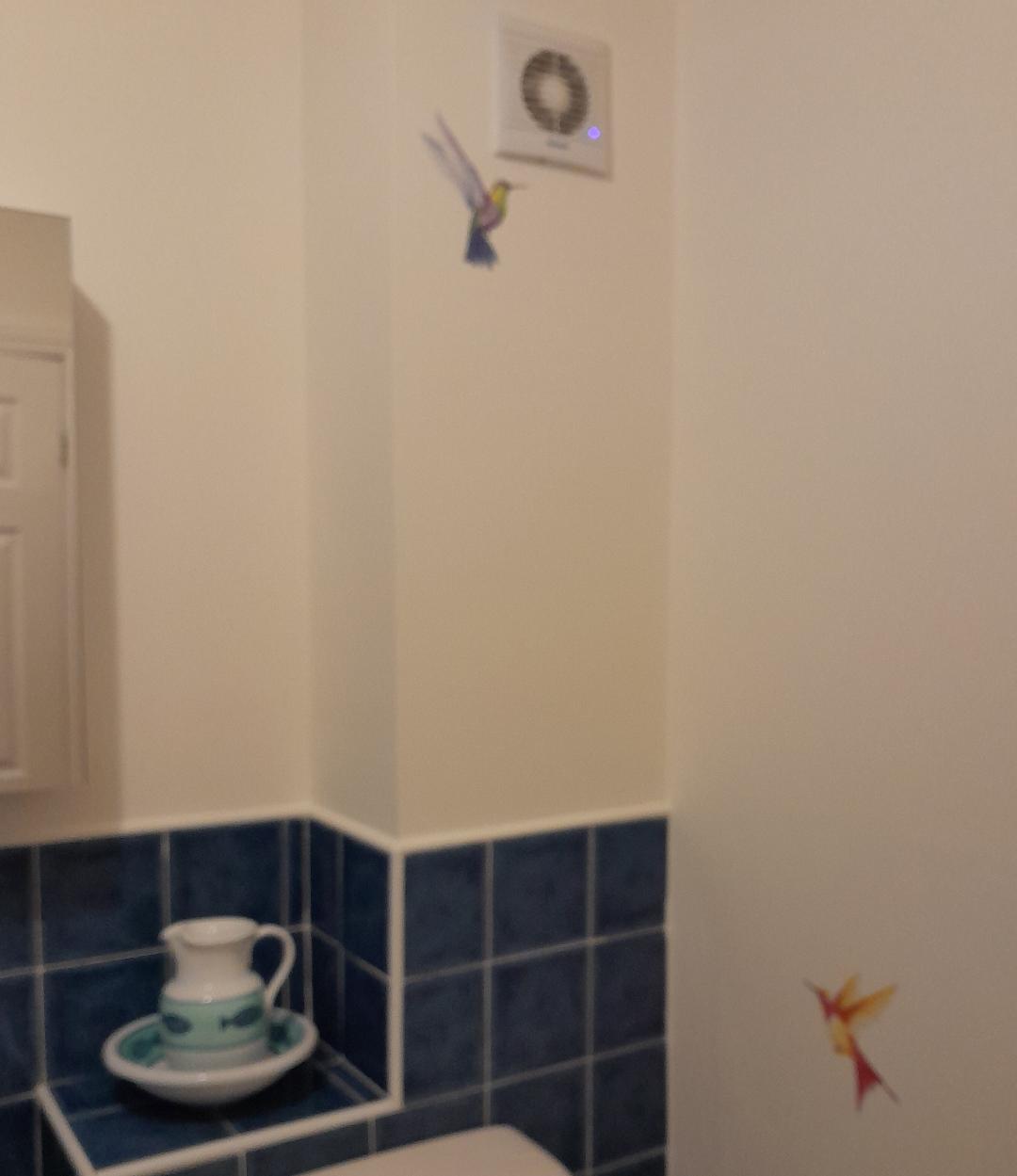

Corner of bathroom showing some of the random bird decals I've stuck on walls.


We attached the mirrored doors, feeling very proud of ourselves, and then noticed that the doors didn’t meet at the front…

“Do you think you can move them a bit by turning these screws on the hinges?’ I asked, tentatively.

“No, don’t touch them – they’re nothing to do with it!’ said P, in a tone that forbad further argument.

That night, lying awake as usual at two o’clock, I considered this again. I looked up ‘How To Fix Gaps In Cabinet Doors’ on my phone, and immediately found five hundred videos showing how you could fix them in the time it takes to mutter 'P, you are an idiot!', simply by turning the screws in the hinges. 

So I got up and did this, and it worked.

The next morning, P rose before me, as he had to go to work. After leaving the bathroom, he popped his head back into the bedroom.

‘I don’t think the gap between the doors is as bad as we thought it was,’ he said.

‘Really?’ I muttered.

‘Or maybe they’ve settled, or something?’ He sounded less sure of himself this time. I just turned over and went back to sleep, figuring it would do him good to assume for a few hours that we’d been visited by the DIY fairies during the night.


Towel rail with new towels and bird decal


Since then, he has put up a towel rail and we have started returning everything to the bathroom.  Who would have thought that two adults could amass such a huge array of Stuff in one bathroom – a bathroom which only had one small cabinet before but now has an additional much larger one (the Stuff has expanded to fill both cupboards edge-to-edge). I mean, we have thrown away all the out-of-date creams and medicines, the multiple bottles of never-used hair products, the never-will-be-used toiletries-for-men bought for P by relatives as Christmas presents, the no-longer-relevant bath toys great-nephew used to love when he was three... So how can there still be such a lot of Stuff to find room for? It’s like we’ve been cursed in some way.


New towel shelves with another wedding present on top, this one a pretty turquoise glass bowl with silver birds swooping round it, given to us by our friend, T. This picture also shows another of the bird decals I put on walls in random spots.


But anyway I’ve had a good excuse to buy some new towels, and I can now brush my hair using a mirror that reflects my whole head and shoulders, rather than just the bit above my nose, without my having to clamber onto a step like a toddler. 

I've also been able to put some bird decals on the walls, which was the most pleasurable part of the whole endeavour.

So life's looking up!


Painting The Study 

Let me lay here for a while
          breathing in this childhood smell. Emulsion paint.
Dust sheets ruched in wormcasts at my toes.
A light-bulb moon above me hangs unlit. 

Spread thin, this blue’s quite dark,
moodier than the turquoise on the tin:
I’m floating in a sea, adrift
in waves of night-blue cloud-dust. 

The slats of the blinds slice the evening light.
Beyond, cars surge and ebb,
the daily wax and wane of other lives.

           But let me rest here, crowd-surfing gentle

fingers of thought, remembering
all the other rooms: grubby magnolia transformed
to rose or tiger-lily, grass or hemp or barely peach.
The shoulder-aching effort, push and drag 

of brush or roller - paintpad once – twisting a room
from that to this. Capturing a dream
that slithers off, that won’t be caught -
replaced by other wraiths – fire-red or Chanel grey, 

sand or cloud or dusk or sunset pink or cyclamon.
Promises that won’t be pinned to the plaster.

            But this sleepy blue’s a lullaby. 
            So let me stay here while the humour lasts.

Louise Wilford


PS: Look what I've just seen outside our house - apparently, this peacock and his mate visit our street regularly though I've never seen them before and no one knows where they come from!


Sunday, March 17, 2024

Art


Here are a few of my latest attempts at painting and drawing. The first is a sketch I did in an art class and then attempted to paint. The paper was too thin so it has ruched a little, and the painting needs further work, but you can see the stages here:


Sketch of jug, vase, platter [charcoal]

Sketch of jug, vase, platter [charcoal, watercolour, acrylics]

Sketch of jug, vase, platter [charcoal]
Sketch of jug, vase, platter [charcoal, acrylic]

Sketch of jug, vase, platter [trying out a different crop]

                                                        jug, vase, platter [nearly there but not quite]


After I have done some serious painting requiring a great deal of concentration, I often feel the need to do some much more free abstract paintings using up the remaining paint. Here are a couple of my recent attempts:


The House On The Hill [acrylics]


Flowers [acrylic]


Thursday, March 14, 2024

Book Reviews - March 2024 - Jasper Fforde, Sarah Painter, Seanan McGuire

Jasper Fforde


Red Side Story


Anyone who has read my book reviews before will know that I am a HUGE Jasper Fforde fan. I adore his quirky novels, finding them funny, highly entertaining, stimulating, clever and unpredictable.

My favourite Fforde novel is Shades Of Grey [not to be confused with that awful book, Fifty Shades of Grey]. He wrote this years ago and it ended on something of a cliffhanger. Since then he has promised a prequel, which never arrived, but finally he has released a sequel, which gives readers some sort of closure.

Personally, I absolutely loved this book. I have no idea what other fans think because I left the rather poe-faced Facebook Fforde fan-group I belonged to for a while, due to getting sick of the unthinking knee-jerk reactions of many people on it to any sort of perceived criticism of Fforde. The Pratchett groups are similar. There is too little genuine enjoyable open discussion of the novels, just uncritical adoration, which isn't my thing. 

Anyway, I felt this novel recaptured the distinctive style of the original book. It wasn't quite so surprising and unpredictable as Book One, as we had already been introduced to many of the weirdnesses of a land ruled by a hierarchy based on characters' perceptions of colour. Nevertheless, there were enough new ideas and interesting twists and turns to keep me reading. The characters were as deliciously absurd, and the plot as ridiculous, as ever. We weren't given a complete explanation for everything [I doubt Fforde has one], but we were told enough to get a happy-ish ending and a sense of jeopardy. I enjoyed every minute and look forward to reading it again.


****** Highly Recommended 


Sarah Painter


This is the second novel in Painter's Unholy Island series, which is itself a spin-off from her excellent Crow Family saga. 

I read the first in the series last year and enjoyed it, against expectations. I think Painter writes very well and I enjoyed all the Crow family books, though [like so many such series] they were starting to become a little repetitive, but I wondered whether a spin-off would work. Maybe the idea had run its course.  However, I discovered that moving the action far away from London, to a lonely island a few miles further north than Lindisfarne, was a surprisingly good move.

With an ensemble cast - though the story tends to centre on Esme the island's ward-witch - Painter skillfully moves around the isolated world she has invented, creating compelling stories. The characters are interesting and complex, the magic mysterious but nevertheless firmly entrenched in the modern world despite the island's distance from the nearest centre of civilisation, and the plots are engaging. 

These books aren't high literature, but if you enjoy contemporary fantasy, you'll probably like them. They have a similar vibe to Ben Aaronovitch's Peter Grant series, with moments of high drama and creepiness but never straying too far into horror.


***** Recommended 


 Seanan McGuire

Over the past few years, I've read a number of novels by award-winning and critically-acclaimed US author, Seanan McGuire, and I've generally been impressed by them.  She writes fantasy books aimed at a predominantly YA audience, but they are definitely worth reading by older readers. If you like imaginative fantasy positioned in a contemporary setting and which definitely isn't 'sword and sorcery' stuff, she might be the writer for you.


The Wayward Children Series


These were the first of her novels that I read, and they are my favourites. There are nine, I believe, in the series so far. They utilise McGuire's propensity for creating peculiar and wildly imaginative worlds. They are loosely focused on a school for children who have been pulled into - and then rejected by - different alternative worlds. Some are worlds that are nonsensical, others logical. Some are terrifying like the gothic 'moors', which are a sort of Hammer Horror movie come to life. The novels, which tend to be short, tell the interweaving tales of different children's adventures and experiences in these various worlds, and describe their longing to return. 

The thing I found so impressive about them is the vividness of McGuire's imagination and writing style. These novels were unlike anything else I'd read. Like all fantasy works, they draw on earlier fantasy tropes. but they contain sparks of brilliance that are dazzling. 

McGuire uses her fantasy framework to explore issues that real-life children often have to deal with, such as mental health, body-image, peer-pressure and the search for identity, and she generally does this well, revealing a great sensitivity for young people, and impressive psychological insight. I do, however, think that the later episodes in this series become increasingly preachy.  


***** Recommended 


The October Daye Series


These books, set in San Francisco, imagine a world where our heroine, October Daye [Toby], is a half-fae detective, fitting in poorly both with humans and fairies. As the novels progress, her life improves and she gathers a scooby-gang of interesting and likeable cronies around her, though she faces increasingly challenging villains and situations.

As always, McGuire's world-building is highly effective. The fairy world exists side-by-side with the human world, mostly concealed from it,  but nevertheless interacting with it.  McGuire's version of 'fairyland' draws on such mythologies as the Tuatha De Danaan and other regional folklore from around the globe, and presents the magical culture as profoundly hierarchical, steeped in virtually unbreakable traditions and protocols. Toby, straddling the fae and human world, moves between the two, generally causing mayhem wherever she goes. 

Toby is a great character, though I grew tired of her frequent urge towards self-sacrifice - she is a hero, after all. She puts herself into life-threatening situations and experiences extreme physical injury repeatedly. I very much enjoyed the use of folkloric characters and I think McGuire explores different species with great imagination. Nevertheless, I was beginning to weary of the slightly repetitive stories - despite McGuire's exceptional imagination, it is simply impossible to sustain so many episodes of a story, even if your characters are near-enough immortal. The only writer I have read who can do this effectively is Jasper Fforde. In his Thursday Next series, he uses all sorts of technically brilliant devices to keep the reader gripped - writing the first person narrative from the viewpoint of alternative Thursdays, 'real' and fictional, and moving round in time, changing the past and the future as he sees fit - it is all breathtakingly creative and rather brave, and McGuire never reaches those heights. Nevertheless, these books are worth a read if you like detective-fantasy hybrids.


**** Recommended with reservations


The Incryptid Series


This series is more light-hearted than either the Toby Daye books or the Wayward Children books. It's central characters are young and beautiful people from a family of crypto-zoologists, people who both fight and look after cryptids (supernatural creatures). The protagonists are superheroes of a sort and the stories are twisty and lively, with dollops of humour and lots of enjoyable fantasy elements and action scenes. Again, I stopped reading because many of the books aren't available on Kindle.

*** Enjoyable 


The Alchemical Series


According to McGuire's comments in these books,, these novels are something she has wanted to write for years and has finally got round to. They are certainly imaginative, original and beautifully written on the whole. 

The first instalment concerns Roger and Dodger, twins created artificially by a dangerous alchemist who wants to rule the world. Roger embodies language, while Dodger embodies maths. Their alchemist creator wants them to embody The Doctrine, a mysterious force that will give them access to The Impossible City. Or something like that anyway. It's hard to follow, to be honest. Roger and Dodger are separated at birth but come together because they can't actually stay apart, and they eventually defeat their evil creator and his very scary minions.

Roger and Dodger have a cameo role in Book Two, but here the action moves to another couple, this time a young couple who are romantically-involved - he is a potential manifestation of Summer and she is a potential manifestation of Winter. Again, the complexity standing behind the plot is hard to grasp, though the story is basically a road-trip with frightening episodes along the way, and then a disappointingly dull denouement.

The ideas behind these stories [McGuire has recently published a third in the series] is quite interesting and original, but they suffer from far, far too much exposition, which just gets worse as the novels progress so that I found Book Two virtually unreadable in places, though I persevered. I became heartily sick of the long and frequent sections in which the characters had seemingly endless conversations about why they were doing the things they were doing. I mean, how many times does something have to be explained to a character before he takes it on board and accepts it?  Yes, in real-life, these fantastical events would be difficult to accept by any sane person, but this isn't real-life and people failing to believe things is simply not compelling for the reader. And also, once you've witnessed magical events, surely that would make you believe in the existence of magic?

There is a great deal of McGuire's writerly magic in these books but ultimately the boring expositional passages and the weak endings, particularly in Book Two, led to my deciding not to read on.
 

** Good ideas, good bits, but ultimately dull 


Thursday, February 29, 2024

February Writer Showcase

 Philip Badger

So far in this series, I’ve showcased the writers Ruth LotenJane LanganBeckCollett, Ron Hardwick, L.N.Hunter,   Katherine BlessanJill Saudek, Colin Johnson, Sue Davnall, Alain Li Wan Po and Lily Lawson. You can find all these showcases by scrolling back through the material on this blog.


Our second showcase of 2024 turns the spotlight onto writer and teacher Philip Badger. Unlike many of the writers who have been showcased here, Philip is not a writer of fiction but a commentator on life - he writes articles which incorporate philosophy, sociology, economics, politics and psychology, many of which have been published in magazines such as Philosophy Now. During the first lockdown in 2020, he wrote a complete book presenting his thoughts on how we might change as a society into a better, kinder nation.


Philip Badger


Biography

Phil Badger was born in an industrial town in the north of England. He had all the usual childhood traumas and vividly recalls standing in the cloakroom of his primary school and thinking about how unfair the world was. Unlike most kids he took the extra step of wondering what a fair world would look like. In retrospect, this was the beginning of his relationship with difficult questions. 

However, his early academic life was somewhat blighted by dyslexia and he didn’t read before he was ten. Phil went on to study Social Sciences and Philosophy at North Staffordshire Polytechnic. After acquiring a few more qualifications, he trained as a teacher and still teaches A level students in semi-retirement. 

From the early 2000s onwards, he’s been a regular contributor to Philosophy Now Magazine and has also featured in that publication’s anthologies of key articles. 

He met his wife, who hails from the same home town, when they were both teaching in London but, as he says, ‘it would be extraordinary if coincidences didn’t happen’.  


 ******


Philip has chosen to showcase one of his most well-known articles which examines the famous thought-experiment popularly known as 'The Trolley Problem'. This article first appeared in the Sep/October edition of Philosophy Now in 2011.


How To Get Off Our Trolleys

        Phil Badger tackles the famous ‘Trolley Problem’ of ethics.

So-called ‘Trolley Problems’, in which we are confronted by tortuously difficult ethical dilemmas, have become part of the stock-in-trade of moral philosophy over the last few years. The basic scenario, which can be endlessly tweaked to provoke ever more rigorous examination of our moral reasoning, concerns a run-away trolley on an imaginary railway line. The trolley is on a lethal collision course with an oblivious group of (say, five) workmen, but can potentially be diverted onto another track by your pulling on a conveniently-placed lever. The problem is that this will place the trolley on a different, equally lethal collision course with an innocent individual.

Readers who haven’t come across this thought-experiment before might pause for a moment to consider what they might do. Some of you will undoubtedly be in favour of hauling on the lever and consigning the poor innocent singleton to oblivion. We can certainly understand why some people might be minded to do so. In the situation presented there seems a clear choice between allowing the deaths of a group of people, and acting to end the life of one. For them the ‘best’ option – meaning the one that will cause the least suffering – is to favour the many. For others the story will not be so simple, and they will draw a distinction between ‘killing’ one individual by active intervention and ‘letting several die’ by remaining passive. This is a distinction we’ll return to later.

Problems With Morality

What we have in this thought-experiment is a place to start thinking about our instinctive moral responses (what philosophers call our ‘moral intuitions’) and the way that these intuitions may or may not cohere together or be capable of any kind of rational justification.

For a so-called ‘act utilitarian’ like Jeremy Bentham (1784-1832), the measure of the moral validity of any particular act is the extent to which it promotes pleasure/benefit and minimises pain/suffering. For Bentham our trolley problem would be a ‘no brainer’: levers would be pulled and our lone protagonist squashed without regret. But an unequivocal utilitarian would be a colder fish than most of us might want to spend any time with. Perhaps one of Mr Spock’s fully Vulcan friends might be an unperturbed ‘trolley diverter’; but the rest of us would be in for a lot of bad dreams. The ‘lever puller’ would deserve our utmost sympathy and support (even if we disagreed with her decision) precisely because we would empathise both with her momentary dilemma and her subsequent anguish.

What this tells us depends on our philosophical perspective. Presumably, Bentham would bemoan our lily-livered sentimentality and remind us of the superior rationality of the utilitarian case. Someone had to die, and it is better, in this case, that it should be some one and not a whole group. Of course this highlights the problem of what we might call the essential ‘relativism’ of the utilitarian position: any act might be permitted and a similar act be prohibited depending on the circumstances. Sometimes it will be acceptable to squash the individual, and sometimes the group (imagine that we recognise the lone individual as a world famous surgeon whom we anticipate will go on to save and improve many lives). Of course, making morality relative to the consequences of actions is, on another level, a morally absolute principle (we must always act to maximise ‘utility’). But this is a principle that most of us find deeply disturbing for the following reason.

Imagine applying our trolley logic to the case of the death penalty. Imagine further that a new study showed that, without question, the death penalty really does cut down the number of murders committed in any given year. Surely, under such (admittedly hypothetical) circumstances, the lever diverting the trolley would be rapidly replaced by the lever operating the executioner’s trapdoor. In fact, the replacement is made easier when we consider that the ‘sacrificed’ individual is likely to be a cold-blooded murderer. The wrinkle here is the word ‘likely’, because, from a purely utilitarian perspective, the occasional execution of an innocent makes no difference to the morality of the death penalty – the net benefit justifies the sacrifice.

At this point some readers might be feeling a little uneasy because they can feel that no slope is slipperier than the one we’re now on. So let’s say that it turns out that executing the family of a murderer is even more likely to produce a net reduction in pain and suffering – perhaps the deterrence effect is so strong that we only need to wipe out one family per year to guarantee a violence-free life for the rest of us.

Or, imagine a further series of trolley-like situations. Firstly, a terrorist group hijacks an airliner and demands that David Cameron be handed over to them for ‘revolutionary justice’. If we do not comply with their demands, they will blow up the airliner and all on board. We might construct a utilitarian argument for not giving in to the terrorists on the grounds that doing so will encourage further outrages of the same kind; but is this the only moral reason not to drag Mr Cameron to his death? Most of us would think not.

Take another situation: a variation on the classic ‘ticking bomb’ problem, in which we are invited to consider the morality of using torture to help discover the location of a device primed to explode with devastating effects on the lives of hundreds or even thousands. We might be sympathetic to the desperation of the field officer who reluctantly gets out his pliers; but what if, to extract the necessary information, they end up being employed on the terrorist’s five-year-old child?

We can’t dodge the ethical issue by claiming that torture doesn’t work, any more than we could by arguing that the death penalty is not an effective deterrent. The point of such thought-experiments is to face up to how utilitarian we actually would be prepared to be when the ‘utility’ of an act is not in question. Does there come a point where we must say that some actions, such as the torture of children, are always wrong, no matter what the net benefit to others may be?

However, again, the answer is not obvious. The problem with the ‘morally absolute’ position is two-fold. Firstly, the consistent utilitarian might insist that we be clear what our limits are to how much avoidable suffering are we prepared to allow in order to keep our hands clean: do we waver when the stakes are sufficiently high? Let’s say torturing the child saves 100,000 lives. Does that make a difference? How about a million? Secondly, what kinds of act do we decide to be beyond the pale?

Shall we reply that morality has nothing to do with consequences, or should we try to find a way in which the consequences can be given a weight, but only so far that they don’t lead to ‘unacceptable’ places? The first position is associated with Kant, and leads to some very odd moral conclusions.

Can & Kant

For Kant, morality was a matter of ‘categorical imperatives’, which are best understood as absolute rules which could be generated by the use of reason by any morally-competent individual. Kant gives three formulations of the categorical imperative which are superficially dissimilar but which turn out to be equivalent. There isn’t space here to do anything like justice to any of the formulations; but, to begin with, we’ll consider his idea that we should only act in such a way as we would will the principle (his word is ‘maxim’) of our action to be a universal law. In other words, we should act only in ways that we would want others to act in similar circumstances.

It is notoriously easy to misread Kant as arguing that the consequences of our actions are what matters in judging their moral rectitude. If we say, as Kant says, that we should only act in ways we wouldn’t mind other people acting, it looks pretty much as if we’re asking ‘what would the consequences be if everyone acted that way?’ But as Michael Sandel has pointed out in Justice (2009), this is not what Kant is saying. In fact, Kant thinks that we need to act towards others in a way that respects what it is in them that I demand is respected by them in me – my capacity for autonomous (self-governing) action. What’s wrong with stealing is not that the world would descend into chaos if everyone did it (this would be a ‘rule utilitarian’ argument), but that in stealing I act without respect for the autonomy of the person I steal from, and so imply that no one’s autonomy matters.

Kant’s view of morality is hugely demanding, and in the words of another of his formulations, asks us to ‘treat others as not a means to an end but as an end in themselves’. Thus for Kantians, utilitarian calculations about the benefits of sacrificing David Cameron, executing the innocent or pulling ‘trolley diverting’ levers are not to be entertained. On this deontological (duty-based) perspective, some things are absolute wrongs.

This position might make us all feel a lot more comfortable than the utilitarian nightmare described earlier; but once again, things are not so easy, because in severing the connection between the morality of an act and its consequences, Kant commits himself to a position many of us find just as difficult.

Famously, Kant argues that to lie is an absolute wrong – how can we respect the autonomy of others if we intentionally deprive them of the truth? This sounds fine until we run into what I’ll call ‘the case of the hidden Jews’. Imagine that you’re hiding a family of Jewish people from the Nazis, and that you have an SS officer at the door asking you if you’ve seen them. Kant does some famous wriggling about such issues, in that he suggests that we’re allowed to fail to give the information (we might tell the SS officer that “there were Jews about at some point in the past”) but not to lie. But this is not very convincing: we all want to say that the moral thing is to lie in the most convincing way possible to save them. In other words, in this and equivalent cases, the terrible consequences of not lying are more important than any abstract principle [see also here].

Attempts at Reconciliation

To say I’ve oversimplified things here might be a bit of an understatement, but the point remains that our ‘moral intuitions’ – our gut instincts – evidently pull us in two directions. At times it seems right that we aim to minimise suffering in a utilitarian style, while, at others, we want to be deontologists (absolutely principled) like Kant. The big question is, can the two positions be coherently reconciled?

If we think a bit more about our David Cameron example, we might get a clue about how to make a start in this direction. One response would be to argue that the terrorists who hijack the plane and threaten to blow it up are responsible, so the terrible consequences of not complying with their demands should not weigh on our consciences. This position, proposed by the neo-Kantian Alan Gewirth in Reason and Morality, (1980), is plausible, but not altogether helpful. One problem with it is that it does not apply to situations in which we cannot blame someone else for our actions. We might suppose that we could try to blame the terrorist for the agonies of his tortured child in the ‘ticking bomb’ case; but very few will be much convinced by this move. Similarly, if we pull the lever in our initial trolley scenario, there can be no doubt that we have chosen to do something and that responsibility rests with us. The same logic applies, for example, to the use of deadly force against civilian populations in war time. Dropping atom bombs might seem justified on grounds of utility – to curtail even more extensive suffering by ending the war – but not on the grounds that the leaders of the other side made us do it.

Another try would be to distinguish between ‘acts’ and ‘omissions’, such that we see ourselves as responsible for the former but not the latter. The most usual employment of this distinction is in distinguishing between ‘killing’ and ‘letting die’ in the case of gravely ill patients nearing the end of life. ‘Killing’ would involve administering drugs to terminate the patient’s life in order to end their suffering, while ‘letting die’ might involve the withholding of treatment in order to hasten death. The problem here is that doing nothing might cause significant amounts of suffering in its own right. Not hydrating or feeding a patient (or not pulling the lever to divert the trolley) might cause more suffering than active intervention. (This is one reason why many philosophers share my sense that the distinction between acts and omissions is inherently dubious.)

Thirdly, we can invoke the so called ‘principle of double effect’, which suggests that we can’t be held responsible for the unintended or secondary effects of particular actions. A terminally ill patient may be given large doses of morphine to alleviate pain, and this might also, incidentally, hasten his death. Or perhaps a leader might believe he can bring an end to some period of terrible human suffering by, for instance, dropping an atomic bomb on a Japanese city. In this case his principle goal is not to kill the maximum number of non-combatants, but rather to save lives in the long run. Similarly, when we pull the lever to divert the trolley, we do not intend the death of the hapless individual who is now in its path, but rather to save the lives of the group who now aren’t. Yet the trolley example is not quite analogous to the atomic bomb scenario, and we have to invoke a famous refinement to make it so. Imagine that we can only save the group by pushing an fat individual into the trolley’s path. Now we have to will the death of the fat man to bring about our goal. This surely feels closer to the situation of nuclear attack that President Truman must have agonised over (ironically, one of the bombs dropped on Japan was codenamed ‘fat man’). Yet by the same logic, we have to acknowledge that killing the innocents is not just a side effect of dropping the bomb, so the principle of double effect does not apply.

Freedom and Sacrifice

Again, we have to face the competing demands of powerful and intuitively plausible understandings of morality. Some things seem wrong no matter what the supposed benefits might be. Torturing children to extract information from the enemy seems to fall under this heading: the ends don’t justify the means. However, the sacrifice of the few for the many is difficult to resist. So if the trolley or the bomb or the hangman’s rope kills a few innocents and saves many, what are we to do? It is easy to be an absolutist when you don’t have Truman’s job, and a true utilitarian will tell us we are just being self-indulgent when we entertain our moral qualms anyway.

At this point let’s consider the psychology of the situation. Firstly, few of us would object to the notion of individual sacrifice when such sacrifice is voluntary. Imagine the fat man hurling himself in the path of the trolley, or Mr Cameron stoically arriving at the airport and, unimpressed by our pleas, handing himself over to the terrorists to face his fate. Under these circumstances, the horror of using a person as a means to an end is transformed to awe at an act of human nobility. Being the beneficiary of such an act would be a huge burden, but less so t han being the beneficiary of the death of an unwilling and terrified individual. This acknowledges our natural revulsion to the horrific injustice perpetrated upon the involuntary sacrifices.

So, where does all this leave us? Can we give a plausible account of morality which takes into consideration both the sense that we have to weigh the consequences of our actions and also the sense that, nonetheless, there are moments when consequences are secondary to higher principles? Perhaps we can, but only at a great cost, which includes substituting Kant’s notion of ‘autonomy’ for a sense of autonomy we’ll find more familiar.

The first point is that autonomy, in the sense of my ability to choose my actions uncoerced by others, doesn’t always matter to us. My freedom is limited by many laws, and yet I don’t feel conspicuously ‘un-free’. In some countries I’ll be fined for crossing a road on a red light, but that doesn’t make me ‘un-free’. What matters supremely is that those things about which I get to make choices are the ones which make life meaningful to me (this is the more familiar, non-Kantian sense of ‘autonomy’). The law doesn’t prescribe my values or my deepest commitments, nor should it. My big life choices must remain matters of non-interference, because robbing me of these things would render my life meaningless to me. Thus, on neo-Kantian grounds, I have to will the same respect for what I call ‘the large-scale concepts of the good’ of others. On this basis, nobody can be handed over to terrorists against their will, unjustly hung, or thrown in front of a runaway trolley. (Although, i n the case of our initial trolley scenario, since there is no possibility of consulting any of the potential victims about what they would choose to do, we might argue that their autonomy becomes irrelevant to the situation and utilitarian considerations become primary. Thus it is right to pull the lever and save the many. We might even decide to ascribe heroic status to the lone victim – after all, she might have decided to sacrifice herself. This is certainly more likely than the whole group of people on the other track doing so for her.)

At this point we might be feeling a little smug because we have, apparently, rendered two plausible but apparently conflicting moral principles compatible. However, I mentioned earlier that there was a cost to my strategy. In making the holding of personal large-scale concepts of the good a criteria for moral status, I’ve opened up two unpalatable possibilities. Firstly, that beings who have no capacity for holding such concepts must be accounted to be morally inferior – which might sound okay until you realise that small children, the mentally ill, the intellectually impaired and animals all come into this category. Secondly, if, for ‘morally immature’ beings, we then make the capacity to suffer the only applicable criteria for their moral consideration, there are no ethical grounds for favouring infant or mentally challenged humans over many other creatures. For some philosophers, such as Peter Singer (Practical Ethics, 1979), this moral equality with animals is not much of a problem – but for others it certainly will be. You might also point out that I seem to have committed myself to the position that a comatose fat man can be dropped onto the tracks without a quibble (we can’t consult him on his large-scale concept of the good, and he’s likely to suffer far less than the fully conscious guy who’ll get quashed if we pull our original lever).

Perhaps, in the end, we have to invoke the collective ‘large-scale concept of the good of society’ (or even humanity) to resolve these remaining issues. Perhaps, to use Rawls’ phrase, we can rely on an ‘overlapping consensus’ about values in society’s concept of large-scale good: no decent human being would want to be saved by information acquired by the torture of a child. Perhaps; but there seems some serious question-begging going on at this point about what’s decent. Yet my hope is that a social consensus on non-negotiable goods is the result of the kind of discussion we’ve been engaged in, rather than being a fairly implausible foundation for it. This is a place to start a conversation and not to end it.

© Phil Badger 2011

Phil Badger teaches philosophy and psychology in Sheffield. He would like to thank Tony Cole for provoking him into writing this article


 ******


And finally we come to The Big

 Interview, in which Philip kindly answers 

writing-related questions and lets us 

into some of his writing secrets...


Greenwich Observatory [photo taken by Donna Davis]


How old were you when you first knew you wanted to be a writer, and what set you off down that journey?

I knew I wanted to write something from a very early age but this was a bit paradoxical considering that I was a dyslexic kid who couldn’t read until I was ten! Academic writing obviously came later.


Tell us about the books and writers that have shaped your life and your writing career.

That’s quite a difficult one. The first book that really grabbed me as far as the quality of the writing was concerned was J. S. Mill’s ‘On liberty’. This is a book of philosophy written in with a kind of luminous beauty. I have to say that some of Wittgenstein’s writing is also stunningly good but, in terms of the impact on my own thinking, I’d say that the American Philosopher John Rawls has the biggest influence. I’d make a bigger claim. In fact – I’d say Rawls was the most important philosopher of the twentieth century.


Have your children, other family members, friends or teachers inspired any of your writing?

I first studied philosophy at North Staffordshire Polytechnic in the 1980s under the guidance of a lecturer called Peter Shott. Pete was’ and still is, a remarkably bright man and a charismatic teacher. I’ve also been lucky to have a wealth of thoughtful and articulate colleagues during my career who have stimulated my thinking in all kinds of ways.


Does the place you live now, or have lived in the past, have any impact on your writing?

There is a tradition in philosophy which denies the significance of place in our thought. Socrates is said to have claimed the he was a ‘citizen of the world’ rather than of Athens (although there is some thought that this is mis-attributed). The thing is that lots of people who write philosophy aspire to produce work which has a kind of ‘universal’ validity and I am no exception. My partner and I lived in Greenwich for nearly a decade and I suppose that place has a significance for me. J. S. Mill lived in Blackheath, near the gates to Greenwich park, and the Royal Observatory is a kind of shrine to our understanding of the physical universe. We have also lived near the oldest Newcomen beam engine in the world. That is a powerful symbol of both modernity and the injustices of class inequality.


Greenwich Observatory


How would you describe your own writing?

I aim to combine academic rigor with a lightness of touch and, I hope, total clarity. I suspect I don’t manage to live up to any of these goals!


Are there certain themes that draw you to them when you are writing?

I’m quite obsessed with certain themes. How free are we? Can we overcome prejudice? Can we reach a consensus about values?


Tell us about how you approach your writing. Are you a planner or a pantser?

I plan everything I write. Writing an article is a bit like I imagine it feels to conduct an orchestra. You have lots of interconnected themes and you have to try to fuse them into a harmonious whole. There are times when I feel I am doing it but nothing is ever really satisfactory.


Where do you get your ideas from?

A great range of places including news and current affairs as well as drama. Science fiction is a good way to place characters in situations which highlight the kinds of debates that interest me. We might wonder, for example, if AI can be classed as living and as having rights (I’m skeptical about the idea that we are anywhere close to producing machines with artificial consciousness, even if they show apparent problem solving abilities).

My relationship with narrative is a complex one. Obviously, fiction can ‘enlarge the circle of concern’ ( as the Philosopher Perter Singer calls it) by asking us to imagine how the world looks from the point of view of others. On the other hand, stories are often driven by the divisions created between heroes and villains, or ‘us’ and ‘them’. Our cultural stories are often a way of creating a kind of group solidarity, and stories about nation and ethnic identity can be especially toxic in these respects.  


Greenwich Observatory [phpto taken by Donna Davis]


They say that successful writers need to be selfish. How far do you agree with this? 

I guess that all our interests compete for our attention and that includes writing. Perhaps it is a paradox but I feel my own work is both an exercise in self-discovery (perhaps even self-creation) and one of communication. I think the urge to know ourselves and to be known to others is a part of the motivation of many writers. To say writing is a selfish activity is probably unfair in the sense that walking in the countryside could also be said to be selfish and yet few would begrudge us the space for contemplation that walking gives us. Writing gives us the chance to focus but, although done in isolation, it can be a deeply social activity because it involves an attempt to communicate. As far as discipline is concerned, I have the luxury of writing when inspiration strikes. At those times, it is more of a compulsion than a choice.


Beyond your family and your writing, what other things do you do?

I have been, intermittently, a keen chess player but I would not define myself as creative in any real sense. I think my principle source of meaning is in my relationships with others and this includes family members and close friends. I once talked about a ‘community of choice’ to mark out those we choose to make part of our lives. I count myself very lucky to know so many people who enrich my life greatly.


Would you describe yourself as a ‘cultured’ person?

I enjoy the philosophical questions raised by and in the arts. Theatre can be hugely thought provoking as can cinema. I’ve given insufficient attention to questions about what counts as ‘art’ (a key philosophical question) but reading fiction plays a relatively limited role in my life. I am sure this is to my detriment.


Are you interested in history and if so does it impact on your writing?

This is, again, a difficult one for me. The history of ideas is hugely important for me and an awareness of the processes that have led us to our current circumstances is too. However, the drive to try to define something that is, in a sense, true for all times and places makes a certain kind of ‘a historical’ perspective important to me. Not all philosophical writers take this line but I am one of those who do.


How did the Covid pandemic affect you as a writer?

It gave me time to think and raised a whole series of questions about power and inequality which we need to continue to address. There is a sense that it also both raised the profile of the state as an essential aspect of our lives and yet also further undermined our faith in a range of political institutions. What worries me most is the way that inequality is driving a divisive kind of popularism which is both intolerant and authoritarian. I think the pandemic provided a kind of interlude in this trend but might have accentuated it in some respects.


There is a lot of talk at the moment about political correctness, about the Woke movement, about cultural appropriation, about diversity. What are your thoughts on this, with regard to writing?

There are things I won’t say for the same reasons that all of us, I hope, hold back from comment. I think we are mostly fairly sensitive to the feelings of others. Furthermore, I think that free comment has to fall short of harassment to be legitimate. However, context is very important. I wouldn’t go out of my way to offend a person of faith for example but, if we are engaged in a debate, I think it is legitimate to make fairly strident comments about the absurdity of certain views. I have no objection to being told that a particular film, let’s say, deals with a distressing theme (my liberty to watch or otherwise is enhanced by that warning) but the idea that we should be protected from distress by some kind of censorship is both absurd and dangerous. Young people, for example, need to know that some people think committing genocide is a good idea. Again, context matters. I want kids to know things but not to wake up in the night screaming.


Where would you place your own work, on a continuum with PURE FANTASY at one end and COMPLETE REALISM at the other?

I don’t write creative fiction but, to the extent I read fiction at all,  it is often of comic fantasy/sci-fy  nature. I really think that people massively underestimate the power of humour to illuminate truth (philosophy is  often about pointing our error and even absurdity ). The writing of people such as Douglas Adams and Terry Pratchett are often both funny and laser beam focused on our follies.


If you have anything else you’d like to tell us, not covered by these questions, feel free to add it here.           

I’ve realized that accepting that I don’t know certain things is ok. I don’t know what the relationship is between consciousness and the physical world and I never will. I don’t know how my brain creates my consciousness or how much reality is dependent on our observation of it. I don’t know what caused the first event to happen, given that all events have causes. I also realise that I have far less freedom than we often imagine ourselves to have. I occasionally ask my students to what extent we choose our own personalities. Of course, we don’t and we are all the products of the interaction between nature and nurture. If we are lucky, we get to have pretty good frontal cortex development (and good impulse control) but while some might find such thoughts depressing I find they make me more forgiving of myself and others. Knowing that there is nothing you’ve done to deserve the hand you got dealt is a great antidote to prejudice. It is also the core idea in the work of Rawls.


******

Thank you very much, Phil, for a brilliant and fascinating showcase. 


******


In March, I will be showcasing 

another of the fabulous 20-20 Club writers: 

Glen Lee

Not to be missed!